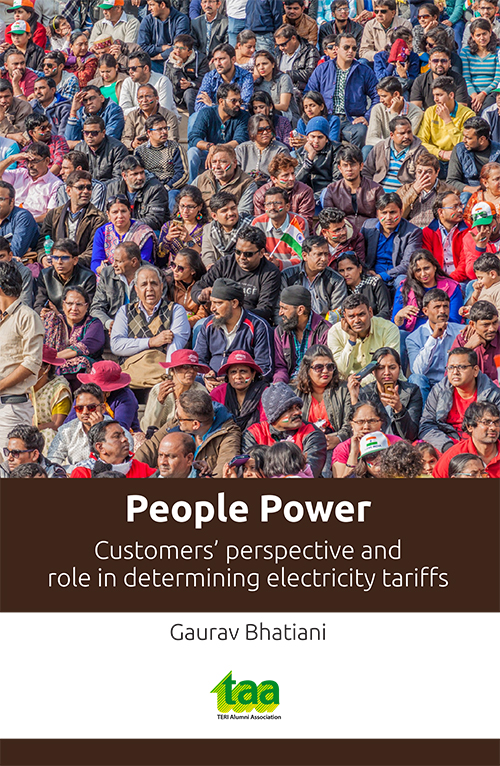
People Power: Customers' perspective and role in determining electricity tariffs
- Author(s): Gaurav Bhatiani
- Size: 140 mm × 220 mm
- Pages: 40
- ISBN: 9789394657687
- Cover Price:
Rs.1.00 / US $1.00
Book Details
All consumers of electricity should read People Power: customers’ perspective and role in determining electricity tariffs to understand how they can participate in decision-making that shapes what consumers pay for electricity. Determining electricity prices, or tariffs, is often seen as a technical matter, to be handled by experts, utilities, and regulators among themselves – the inner circle as it were – but this book shows that consumers have a recognized role in the process and explains the place of that role in law and how such participation is meant to work in practice.
The book describes the formal spaces in which consumer participation is expected, such as formal public hearings related to electricity tariffs, public consultations, and regulatory reviews. By understanding these mechanisms, customers can see that their participation is not symbolic but an integral part of the decision-making framework itself.
At its core, the book contains practical strategies – what consumers should do – to guide customers to engage in the process in a structured way. Simultaneously, the book also outlines the role of regulators– what regulators should do – to enable consumers to participate and contribute in a meaningful manner.
Overall, People Power: customers’ perspective and role in determining electricity tariffs helps consumers move from being passive recipients of electricity bills to active participants in determining how much they should pay. The book provides the insights you need as a consumer to engage with institutions, follow procedures, and contribute to more transparent and balanced electricity pricing decisions.
Target Audience
-
Electricity consumers and consumer groups, policymakers, regulators, utility professionals, researchers, legal practitioners, civil society organizations, students, DISCOMs, industry associations, and development agencies interested in electricity tariff regulation and consumer participation.
Table of Contents
Foreword
Introduction
Evolution of the process of determining tariffs for electricity in India
The pre-reform era
The Electricity Act, 2003
Customer participation in determining tariffs under the Electricity Act, 2003
Legal provisions
Economic logic
Social construct
Institutional architecture
The customer's role in practice
Evidence from states
Consequences of weak or limited participation
International experience
Practical steps to enhance customer engagement in electricity tariff regulation
Start engagement early
Frame questions carefully
Strengthen the tariff-hearing processes
Institutionalize customer representation
Embed ‘customer challenge’ to network investments
Prioritize vulnerable and high-risk customers
Present choices with costs and benefits
Encourage digital platforms, but offer multiple channels
Ensure that all submissions by utilities are open and searchable
Review and improve engagement annually
Goods and services tax in the electricity sector
Why and how consumers should advocate for this reform
Conclusion
Appendix A Some consumer groups active in electricity sector
Bibliography
Keywords
You may also like...
-
 TERI Energy & Environment Data Diary and Yearbook (TEDDY) 2023-24
Regular Price 1995.00
Special Price 1795.00
TERI Energy & Environment Data Diary and Yearbook (TEDDY) 2023-24
Regular Price 1995.00
Special Price 1795.00
-
 Rising Ambition: Carving New Pathways – India's Energy Transition
Regular Price 495.00
Special Price 445.00
Rising Ambition: Carving New Pathways – India's Energy Transition
Regular Price 495.00
Special Price 445.00
-
 Smart Energy Practices for a Sustainable World: How We All Can Contribute?
Regular Price 1195.00
Special Price 1075.00
Smart Energy Practices for a Sustainable World: How We All Can Contribute?
Regular Price 1195.00
Special Price 1075.00
-
 From Lattus to Lasers: Realising India’s Electricity Potential
Regular Price 299.00
Special Price 270.00
From Lattus to Lasers: Realising India’s Electricity Potential
Regular Price 299.00
Special Price 270.00