| World Digital Libraries: An International Journal (WDL) Vol.19(1) June 2026 Print ISSN : 0974-567X Online ISSN : 0975-7597 |
Evaluation of Content, Usability, and Digital Services of Medical Institute Library Websites in India: a comparative study |
Ms N. Suyal Dr Margam Madhusudhan |
| DOI: 10.18329/09757597/2026/19103 |
Introduction |
|
The World Wide Web (WWW) and the Internet have transformed access to medical knowledge by enabling rapid, convenient, and interactive information retrieval. Their dynamic nature has led to a growing reliance on digital platforms for clinical decision-making and effective utilization of health services. In this context, the credibility, quality, and reliability of health-related websites are of paramount importance. Libraries play a crucial role in health education by providing access to scientific literature, evidence-based resources, and research materials for health care professionals and scholars. Through their websites, libraries facilitate seamless access to e-books, databases, and other digital tools that strengthen theoretical understanding and support academic and clinical practice. For medical libraries, maintaining regularly updated, inclusive, and user-oriented websites is essential to ensure comprehensive access to current medical guidelines, procedures, and scholarly content. Library websites serve as vital communication platforms, integrating digital resources, supporting distance learning, fostering research collaboration, and expanding access to electronic collections. However, challenges persist, including ensuring content credibility, aligning website design with user expectations, and enhancing usability. The study discussed in this article evaluates the library websites of the top medical institutions ranked in the NIRF 2024, using systematic content analysis to assess their quality, scope, accessibility, and user orientation. By examining structural design, information depth, and service integration, the research identifies strengths and gaps in current web practices. It highlights opportunities to improve medical library portals to serve academic and health care communities better. |
|
| Extensive research has been conducted to promote the development of high-quality, user-oriented websites and webpages. Given the rapid growth and turnover of web platforms, concerns regarding the credibility, relevance, and reliability of online information persist. Particularly in the health domain, where users increasingly depend on digital sources, website design must prioritize accuracy, usability, and alignment with user needs. This section reviews existing literature on the content analysis and usability evaluation of medical and academic library websites. The studies are organized into two thematic categories: (i) content analysis of websites and (ii) usability evaluation of websites. |
|
|
Medical and academic library websites serve as primary gateways to information resources; hence, systematic content evaluation is essential. Content analysis, a structured method for examining textual and visual materials, enables the assessment of accuracy, comprehensiveness, currency, credibility, and presentation quality. Recent studies demonstrate varied levels of development among library websites. Madhu and Kannappanavar (2024) found that while most pharmacy institute libraries provided core resources and copyright information, limited adoption of Web 2.0 tools was observed. Ullah (2024) emphasized the need for improved design and maintenance in Pakistani medical college libraries. Gohain, Mishra, and Mera (2023) reported that many central university libraries in north–east India maintain portals with basic service information but limited advanced features. Brahma and Verma (2022) identified widespread use of graphics and online public access catalogue (OPAC) links among Asian national libraries, though Web 2.0 integration varied. Rafiq, Ashiq, and Rehman (2021) highlighted strong integration of digital resources among leading global medical universities, while Rekha and Chandrashekara (2020) recommended greater emphasis on e-resources and dedicated library webpages in Indian medical colleges. |
|
|
Usability evaluation has emerged as a critical research area, as library websites increasingly function as primary access points to services and collections. Effective usability enhances navigation, information retrieval, engagement, and overall user satisfaction. Aditia, Rahmi, and Buduroh (2024) reported generally positive user experiences at Universitas Indonesia Library but identified design shortcomings. Tembo, Akakandelwa, and Phiri (2023) found limited functional library portals in Zambian higher education institutions and recommended redesign to improve service delivery. Rahmandita (2022) observed that public university libraries in Indonesia and Malaysia performed better in user experience than private institutions. Tella (2022) identified navigation as the most influential usability factor in Nigerian university libraries. Yadav and Mishra (2021) noted limited Web 2.0 adoption among Indian Institutes of Science Education and Research (IISERs) library websites in India, while Anyaoku and Pract (2020) emphasized improvements in accessibility, interactivity, and OPAC integration in Nigerian university libraries. The reviewed studies indicate progress in digital library development but reveal persistent gaps in advanced features, usability standards, accessibility, and interactive technologies. These findings establish the need for a systematic evaluation of medical institute library websites to enhance their effectiveness, user-friendliness, and technological robustness. |
Statement of Problem |
|
The fundamental purpose of a health organization’s website is to deliver accurate, reliable, and easily accessible health information to the public. As the primary interface for individuals seeking medical information online, such websites must ensure credibility, clarity, usability, and user engagement through well-structured design and authoritative content. With rapid technological advancements reshaping education, research, and health care, digital platforms have become indispensable tools for information access. Users increasingly prefer remote and immediate access to knowledge resources rather than relying solely on physical visits. Within medical institutions, libraries function as central knowledge hubs supporting students, faculty, researchers, clinicians, and health care professionals. The expansion of library services through web platforms has significantly enhanced access to scholarly resources, enabling timely and efficient retrieval of information. However, the growing reliance on digital interfaces necessitates systematic evaluation of medical library websites to ensure content accuracy, reliability, currency, and usability. A review of the existing literature indicates the absence of a comprehensive, structured evaluation of medical library websites in India. Although scattered assessment criteria exist, a unified analytical framework remains underdeveloped. Accordingly, the present study addresses this gap by undertaking a systematic ‘Content Evaluation of Library Websites of Medical Institutions of India’ and proposing a structured model for their effective design |
Objectives of the Study |
|
To examine the content features of library websites of selected medical institutes in India. To develop a structured framework for evaluating the quality and effectiveness of website content. To assess the validity, reliability, and utility of the information presented. To compare and rank the selected websites based on defined evaluation parameters. To recommend strategies to improve content quality and enhance the functional effectiveness of medical institute library websites. |
Scope and Methodology |
|
The study focuses on the top-20 medical institutions ranked under the National Institutional Ranking Framework (NIRF) India Rankings 2024 (Medical) issued by the NIRF, Ministry of Education, Government of India. The selected institutions constitute the sample for systematic content evaluation, as presented in Table 1. 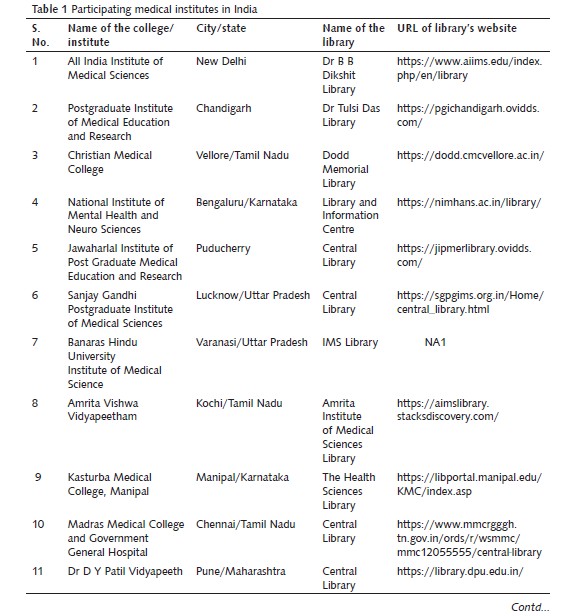 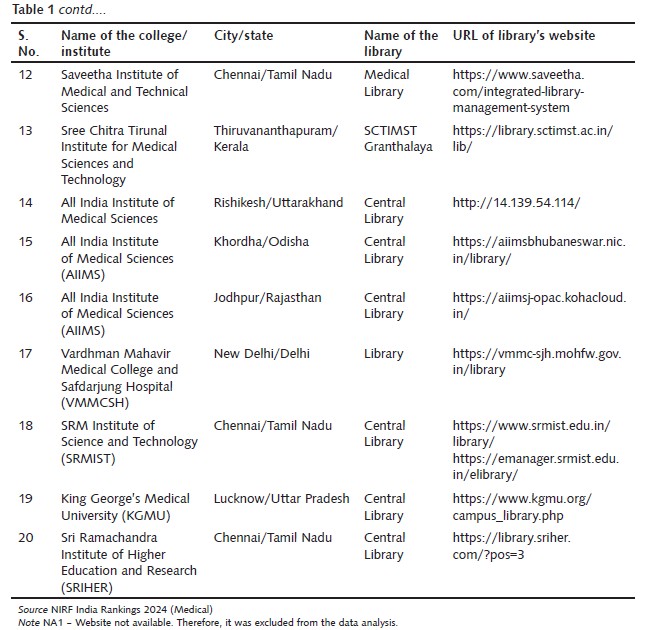 The study sample comprises the top-20 medical institutions ranked in the NIRF India Rankings 2024 (Medical), as presented in Table 1. By focusing on these leading institutions, the study examines how premier medical organizations in India use their online platforms, particularly library websites, to communicate and deliver services to students, faculty, researchers, health care professionals, and the wider community. During the evaluation period, however, the library website of Banaras Hindu University (BHU) (S. No. 7 in Table 1) was non-functional and therefore excluded from analysis. Accordingly, the final sample comprises 19 functional medical institution library websites. A manual evaluation method was utilized for this study. Qualitative and quantitative data were gathered and evaluated using structured checklists across various parameters. A total of 164 checklist indicators were developed to systematically gather relevant information. The collected data were organized under specific thematic areas, and a comparative analysis was performed to assess performance by category and identify overall effectiveness. The quantitative evaluation framework included the following categories: Multimedia Features, Web 2.0 Features, General Information, Library Services, Library Resources, Currency, Accuracy, and Relevance, Organization and Structure, Links and Navigation, Searching Features, and User Interface and Support Features. The evaluation approach taken in the study is similar to Madhusudhan and Ahmed (2013) with major modifications. |
Analysis and Interpretation of Data |
|
This comprehensive evaluation systematically examines the descriptive and technical characteristics of medical institute library websites, recognizing their critical role in disseminating digital information and delivering services within medical academia. Data were collected using a rigorously developed checklist, applied consistently over two months from 15 May 15 to 15 July 2025. The evaluation process involved approximately 95 hours of detailed observation, ensuring consistency and reliability in data recording and analysis. The evaluation instrument comprised 164 dichotomous indicators grouped under 11 major categories. Each feature was assessed using a binary scoring system, where ‘1’ indicated presence and ‘0’ indicated absence. The findings are presented in two segments: (i) qualitative evaluation, offering descriptive and technical insights, and (ii) quantitative evaluation, providing statistical comparison and performance trends. Results are illustrated through 14 structured tables to highlight key patterns and institutional variations. |
Qualitative Evaluation |
|
The qualitative assessment focused on ten descriptive and technical parameters, including library name, address, contact details, domain type, browser compatibility, and content-related attributes. These indicators were primarily examined through the homepage of each selected library website (Table 2). A score of ‘1’ was assigned where a feature was present. 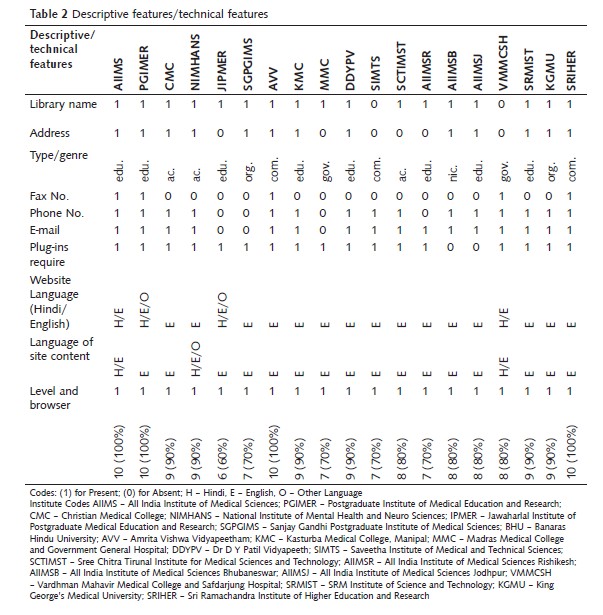 Descriptive/Technical Features of Website Analysis of Table 2 reveals that most websites incorporate fundamental descriptive and technical elements. While 89.47% display the library name and 68.42% provide physical addresses, incomplete contact information on some sites may reduce user accessibility. E-mail (84.21%) and phone numbers (78.94%) are widely available, whereas fax numbers are available only to a limited extent, reflecting changing communication trends. Domain usage varies across educational, governmental, organizational, and commercial extensions, indicating a lack of standardization. Although all websites ensure browser compatibility and most specify plug-in requirements, multilingual support remains limited, with only five institutions offering non-English content. In terms of overall qualitative scoring, AIIMS Delhi, PGIMER, AVV, and SRIHER achieved full scores, while JIPMER recorded the lowest performance, indicating areas requiring enhancement. The findings suggest that although foundational web features are largely in place, improvements in contact transparency, multilingual access, and domain consistency enhance usability and institutional visibility. |
Quantitative Evaluation |
| The quantitative component of the study comprised 154 structured checkpoints designed to systematically evaluate medical institute library websites. These indicators were organized into ten major evaluative categories to ensure a comprehensive and objective assessment. Data were collected directly from each website using the standardized checklist. A binary scoring system was employed, whereby the presence of a feature was assigned a score of ‘1’, and its absence was marked ‘0’. The cumulative scores formed the basis for comparative and category-wise performance analysis. |
Multimedia Features |
|
Table 3 presents the assessment of multimedia features across 19 medical institute library websites. Multimedia elements—including audio, video, animations, and graphical components, are essential for enhancing user engagement, accessibility, and information delivery. However, the findings reveal substantial limitations. 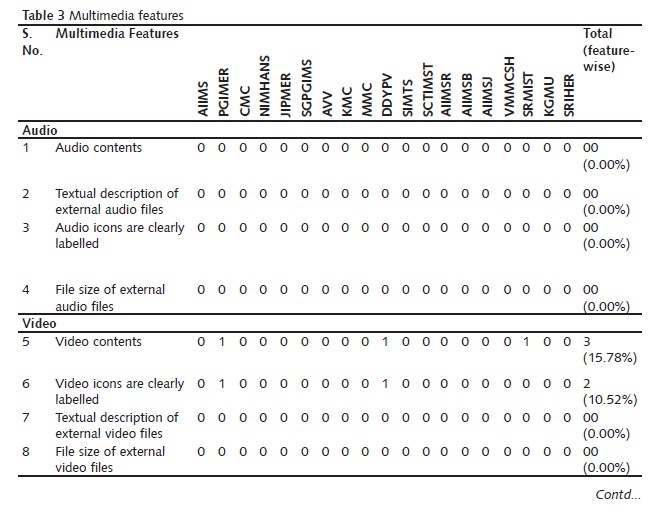 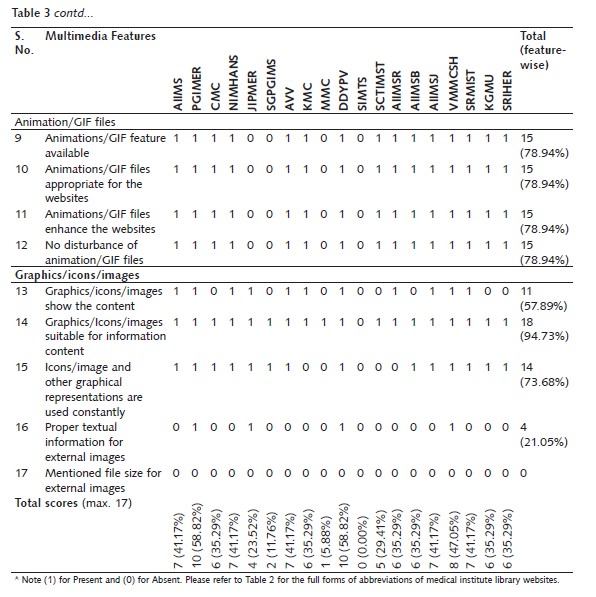 None of the evaluated websites incorporated audio files or associated metadata, highlighting a significant accessibility gap, particularly for visually impaired users. Video integration was also minimal; only three institutions (15.78%) hosted video content, and merely two (10.52%) used clearly labelled video icons. No website provided descriptive transcripts or file-size information, indicating limited accommodation for screen-reader users or those with bandwidth constraints. Animations and GIFs were more commonly observed (78.94%) and were generally implemented without affecting readability. Graphics and icons appeared on 94.73% of websites, although only 57.89% demonstrated purposeful usage. Consistent graphical design was maintained by 73.68% of institutions, yet alt-text provision was limited (21.05%), and file-size disclosure was absent. Multimedia scores (maximum 17 points) varied considerably. PGIMER and DDYPV achieved the highest scores (58.82%), followed by VMMC and Safdarjung Hospital (47.05%), whereas SIMTS scored 0% due to the absence of multimedia elements. These findings emphasize the need for enhanced accessibility standards and for structured multimedia integration on medical library websites. The scores shown in Table 3 are included in the overall evaluation and are later added to the final combined results presented in Table 13. |
General Information About Library Websites |
|
The analysis of general information features presented in Table 4, covering 32 indicators across 19 medical institute library websites, reveals noticeable differences in content completeness and quality. Basic information, such as library timings (94.74%), homepage access (89.47%), and contact details (84.21%), is available on most websites, reflecting compliance with fundamental service standards. However, several advanced and user-focused features are largely missing. Chatbot or AI-based assistance tools are absent (0%), while library e-newsletters (10.53%), barcode systems (10.53%), and FAQs (15.79%) are minimally represented. Similarly, transparency-related elements such as budget reports, usage statistics, and downloadable forms appear on fewer than one-fourth of the websites. Institutional performance varies significantly. AIIMS Delhi ranks highest, offering 24 out of 32 features (75%), followed by SRMIST (68.75%) and KMC (65.63%), indicating relatively strong digital engagement. In contrast, SIMTS provides only one feature (3.13%), reflecting a very limited online presence. Other institutions, including MMC, AVV, DDYPV, and SCTIMST, also show considerable shortcomings. Table 4 suggests that only a few institutions maintain comprehensive and user-oriented general information sections. However, these scores are preliminary and contribute to the cumulative evaluation summarized in Table 13. 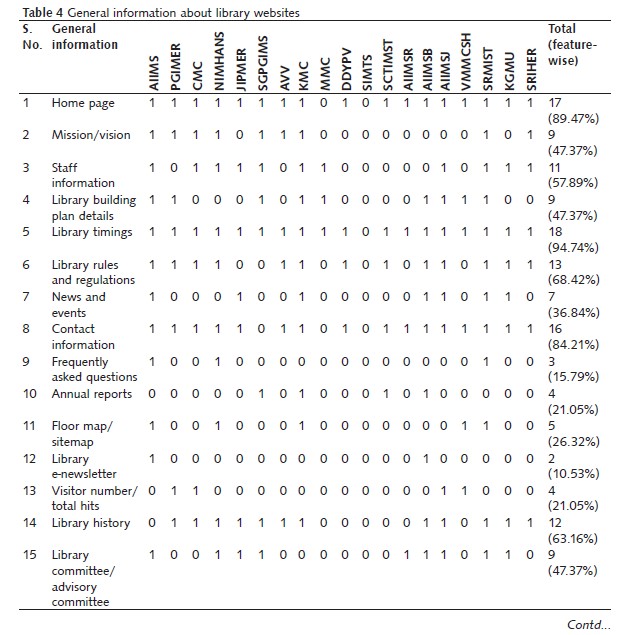 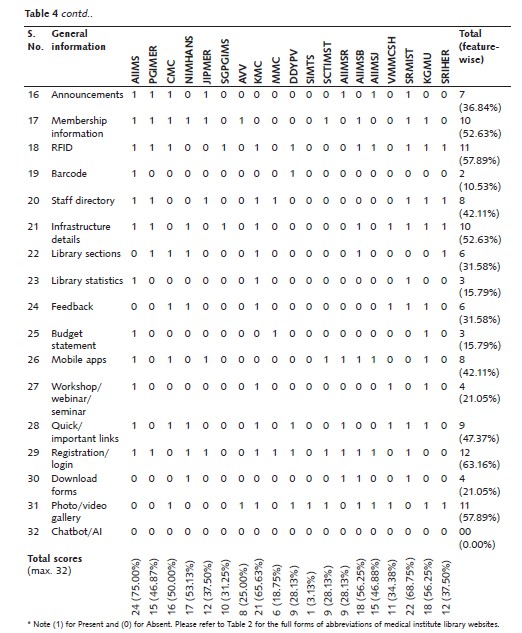 |
|
|
Table 5 assesses the availability of 25 key library service features across 19 medical institute library websites in India and highlights marked differences in service provision. Foundational services are widely available: ‘Other services’ are listed by all institutions (100%), followed by ‘reference services’ (84.21%), ‘internet/Wi-Fi’, and ‘photocopying’ (78.94%), and ‘circulation and reading/conference room facilities’ (73.68%). This indicates that core infrastructure and traditional user support mechanisms are largely in place. In contrast, advanced, research-oriented, and inclusive services are adopted only sparingly. Faculty publication display and table of contents services are available at only one institution (5.26%), while ‘alert services’ are available at two institutions (10.52%). ‘Referral services’, ‘newspaper clippings’, ‘current awareness/Selective Dissemination of Information (SDI)’, and ‘literature search services’ range between 15.78% and 21.05%. ‘Research support tools, citation style tools’ (36.84%), ‘paraphrasing tools’ (47.36%), and ‘anti-plagiarism services’ (57.89%)—are unevenly implemented. Accessibility provisions, such as ‘screen reader access’ (26.31%), remain insufficient. At the institutional level, AIIMS Delhi leads with 20 of 25 features (80%), followed by PGIMER and KMC (72% each). Conversely, MMC and SIMTS (20%), SGPGIMS (24%), and JIPMER (28%) reflect limited digital advancement. These results feed into the consolidated rankings presented in Table 13. 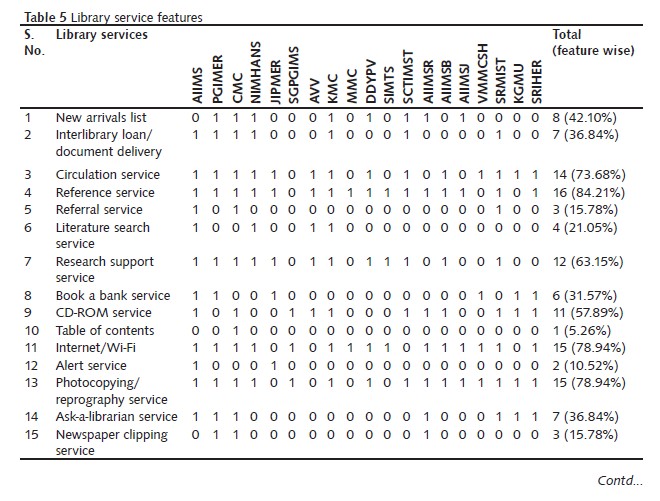 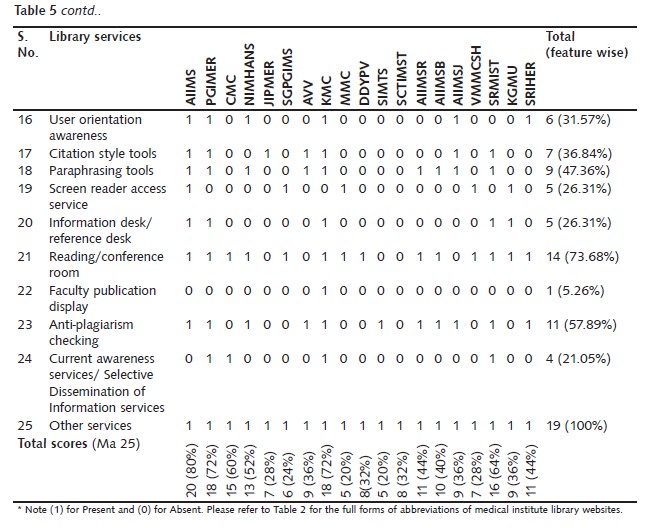 |
|
|
Table 6 analyzes the availability of 23 major library resource features across 19 medical institute libraries in India. The findings indicate strong foundational collections but highlight deficiencies in specialized and inclusive resources. Core resources—such as ‘physical collections’, ‘faculty services’, and other ‘general resources’—are present in all institutions (100%), reflecting consistent support for fundamental academic requirements. ‘Electronic journals’ are widely available (94.73%). At the same time, ‘E-books’, ‘full-text’, and ‘bibliographic databases’, ‘open access resources’, and ‘remote access facilities’ are each accessible in 84.21% of libraries, demonstrating significant integration of digital resources. Resources with a moderate presence include ‘online reference sources’ and ‘open educational resources’ (78.94%), as well as free ‘E-books’ and ‘multimedia databases’ (73.68%). However, advanced and inclusive services remain limited. Only 15.78% of libraries provide online union catalogues or PwD-specific information, and online tutorials are available in 21.05% of institutions. ‘Rare collections’ (31.57%) and ‘institutional repositories’ (47.36%) also show relatively low adoption. AIIMS Delhi, AIIMS Rishikesh, and SRMIST lead with 86.95% resource availability. Conversely, MMC and VMMC and Safdarjung Hospital (26.08%) and SGPGIMS (34.78%) demonstrate comparatively weaker resource infrastructures. These results are incorporated into the consolidated rankings in Table 13. 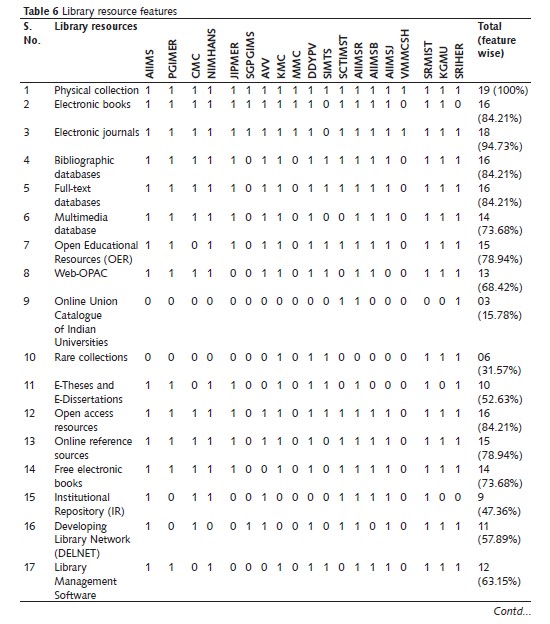 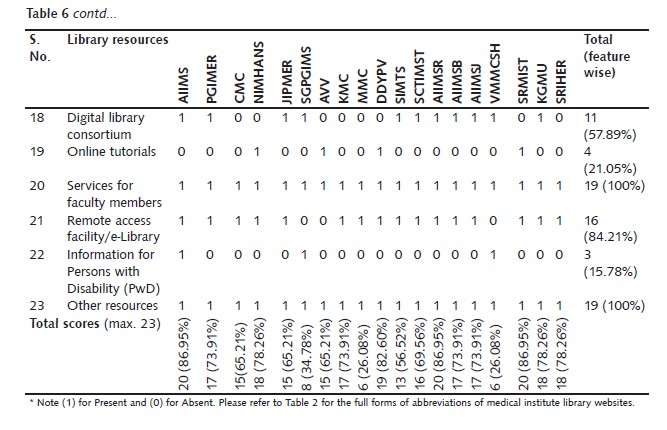 |
|
|
Table 7 examines the implementation of Web 2.0/Library 2.0 features across 19 medical institute library websites in India. The findings indicate that the adoption of interactive, user-driven technologies remains generally low, highlighting a significant gap in modernizing digital library services. Among the evaluated features, ‘social networking links’ and ‘widgets’ are the most commonly adopted, each implemented by eight libraries (42.10%), reflecting moderate efforts towards user engagement. Really simple syndication (RSS) feeds and YouTube integration are present in five libraries (26.31%), indicating limited use of content syndication and multimedia outreach. However, several key Web 2.0 tools are either minimally adopted or absent. ‘Social tagging’, ‘bookmarking’, ‘PlumX Metrics’, and ‘Podcasts’ are not implemented by any institution (0%). Features such as Blogs, Calendars, Virtual Tours, Weather Updates, Wikipedia links and instant messaging appear in only one library each (5.26%). QR Codes (21.05%) and virtual help desks (10.52%) are also limited. Institutionally, SRMIST leads with 37.5% adoption, followed by PGIMER and KGMU (31.25%). In contrast, SGPGIMS, SIMTS, and SCTIMST show no implementation. These results are incorporated into the consolidated evaluation in Table 13. 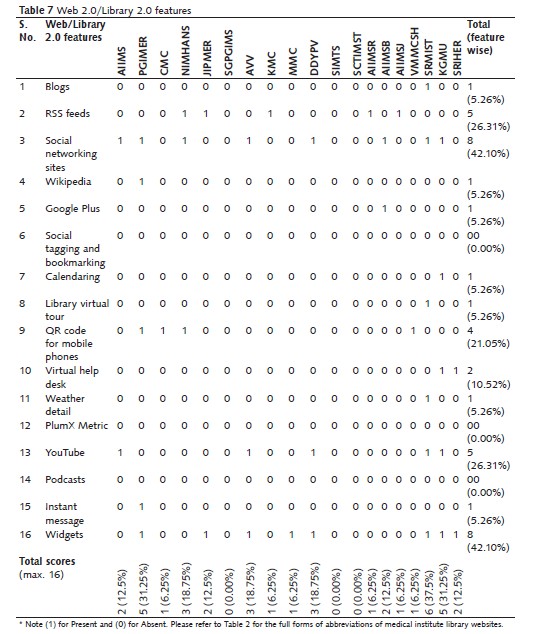 |
|
|
Table 8 assesses five key quality parameters, currency, accuracy, and relevance, across 19 medical institute library websites in India. The findings demonstrate noticeable variation in compliance with fundamental web quality standards. The official institute logo is the most consistently implemented element, appearing on 17 websites (89.47%), indicating strong institutional identity. Copyright statements are present on 14 websites (73.68%), reflecting moderate attention to legal and ownership information. Accuracy, referring to the correctness and technical reliability of content, shows mixed performance. Eleven websites (57.89%) are free from broken or dead links, suggesting reasonable maintenance practices. However, only eight websites (42.10%) are free from grammatical or spelling errors, indicating room for improvement in content quality control. Currency remains a major concern. Only seven websites (36.84%) display the date of last update, limiting transparency regarding content freshness and potentially affecting user confidence. Institutionally, PGIMER, VMMC and Safdarjung Hospital, and SRMIST achieve full scores (5/5). In contrast, MMC and AIIMSR record the lowest scores (1/5), reflecting deficiencies in essential quality indicators. These results are incorporated into the consolidated performance rankings presented in Table 13. 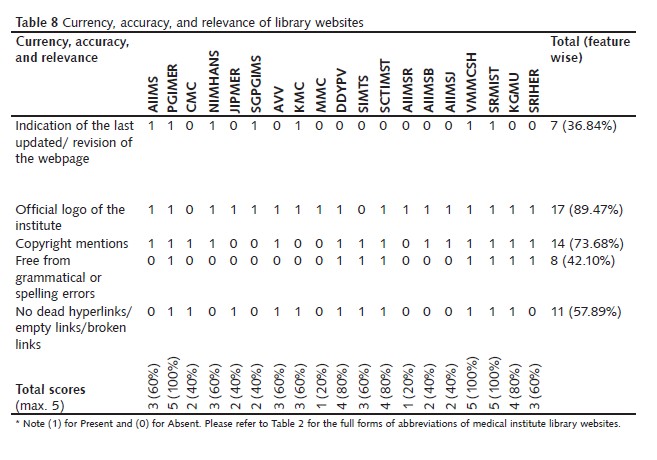 |
|
|
Table 9 evaluates the organizational and structural design of 19 medical institute library websites in India using ten usability and accessibility indicators. The findings suggest that most websites maintain sound structural foundations. Essential features, such as cross-browser accessibility, absence of password barriers, avoidance of technical jargon, and clear page titles, are present in all institutions (100%). Responsive design and alignment with user needs are observed in 18 libraries (94.73%), demonstrating strong attention to device compatibility and content relevance. Website architecture generally follows hierarchical, linear, or mixed structures. However, only 12 libraries (63.15%) use dropdown menu navigation, indicating an inconsistent integrated navigation design. Accessibility support remains limited; only five institutions (26.31%) offer font resizing or colour adjustment options. Horizontal scrolling, which negatively affects usability, appears in three websites (15.78%). Institutional performance varies. AIIMS, NIMHANS, MMC, AIIMSR, VMMC and Safdarjung Hospital, SRMIST, KGMU, and SRIHER achieve the highest scores (90%). SIMTS ranks lowest (50%), indicating structural deficiencies. These results contribute to the consolidated evaluation summarized in Table 13. 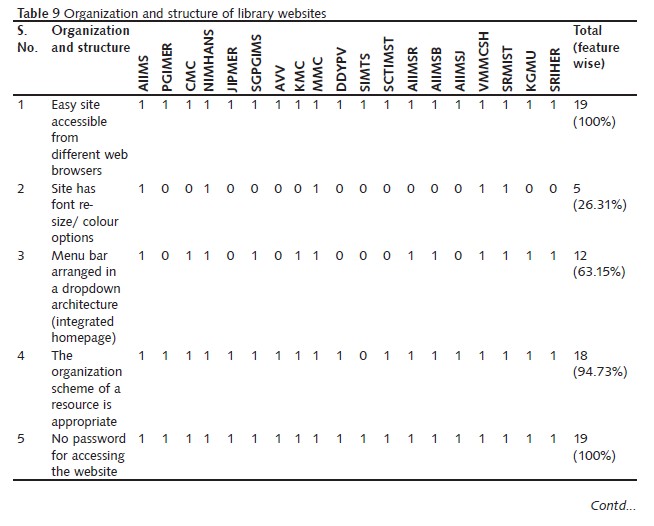 |
|
|
Table 10 evaluates six key features related to website links and navigation across 19 medical institute library websites in India. These elements are essential for ensuring smooth, intuitive, and efficient access to both internal resources and external information sources. Among the assessed features, ‘easy navigation labels/menu bars’ are the most widely implemented, appearing on 18 websites (94.73%), reflecting a strong emphasis on user-friendly interface design. Four link-related indicators, clearly described external links, links to the parent institution’s homepage, connections to credible external resources, and functional internal links are each present in 17 libraries (89.47%), demonstrating consistent attention to link accuracy and reliability. However, only 12 libraries (63.15%) provide a ‘move to top/bottom’ page option, indicating limited adoption of advanced navigational aids. At the institutional level, AIIMS, NIMHANS, JIPMER, DDYPV, SCTIMST, AIIMSB, AIIMSJ, VMMC and Safdarjung Hospital, KGMU, and SRIHER achieve full scores (6/6). In contrast, MMC records the lowest performance (2/6), highlighting significant navigational gaps. These results are incorporated into the consolidated evaluation presented in Table 13. 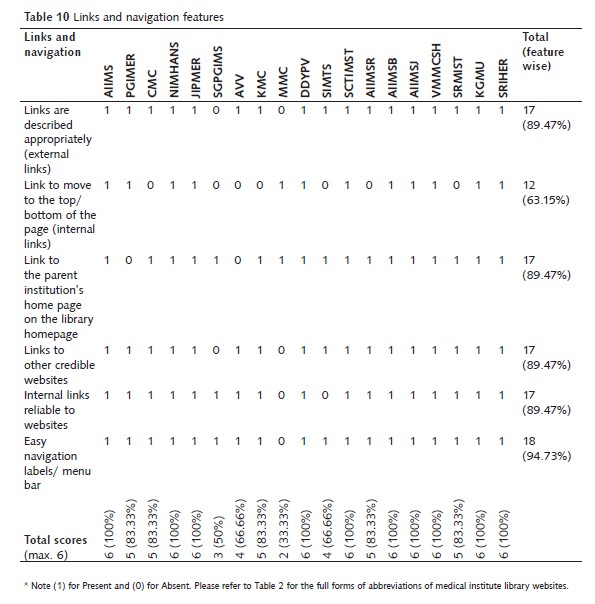 |
|
|
Table 11 evaluates ten search-related features across the library websites of 19 medical and health science institutions in India. These features are essential for enabling efficient information retrieval and enhancing the overall user experience. The most widely implemented feature is ‘keyword/field search’ with truncation or wildcard options, available in 14 libraries (73.68%). Search results displayed in a clear, understandable format are present on 13 websites (68.42%). Site ‘search/search engine’ functionality and ‘browse options’ are each available in 12 libraries (63.15%), indicating reasonable foundational search support. Boolean operators and search filters appear on 10 websites (52.63%), reflecting moderate implementation of advanced search tools. More specialized functionalities are less common. Federated Search is available in 9 libraries (47.36%), while bookmarking or saving search results is available in 7 libraries (36.84%). Search guidelines/tips and search history functions are each found in only five libraries (26.31%), suggesting limited user guidance. Institutionally, AIIMS, JIPMER, AIIMSB, and AIIMSJ lead with 90% implementation. In contrast, MMC, SIMTS, and SGPGIMS show no search-related features, indicating major deficiencies. These results are integrated into the overall ranking presented in Table 13. 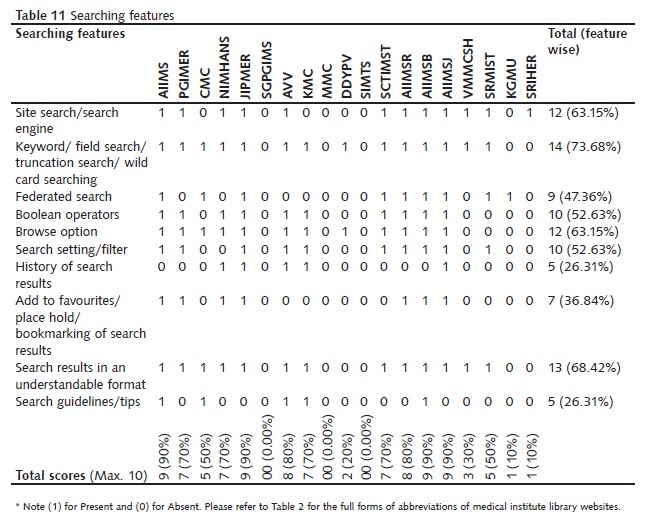 |
|
|
Table 12 assesses user interface and support features across 19 medical institute library websites. The findings indicate that fundamental usability standards are largely maintained. Core elements, such as fast page loading (within 30 seconds), absence of distracting scrolling or blinking text, and access to desired content within three clicks, are implemented by all institutions (100%), demonstrating strong basic design efficiency. Additionally, 18 websites (94.73%) provide a homepage return option, visually appealing layouts, and advertisement-free interfaces, reflecting attention to clarity and aesthetic consistency. However, advanced support mechanisms are less consistently adopted. System status notifications are available on 47.36% of websites, user manuals on 36.84%, and help desk support on only 31.57%. Importantly, none of the websites offers system-generated user guidance, indicating a significant shortfall in contextual assistance. At the institutional level, AIIMS Delhi, PGIMER, and AIIMSB achieve the highest scores (90%). SIMTS records the lowest performance (30%), highlighting substantial scope for improvement. These findings are incorporated into the consolidated rankings presented in Table 13. 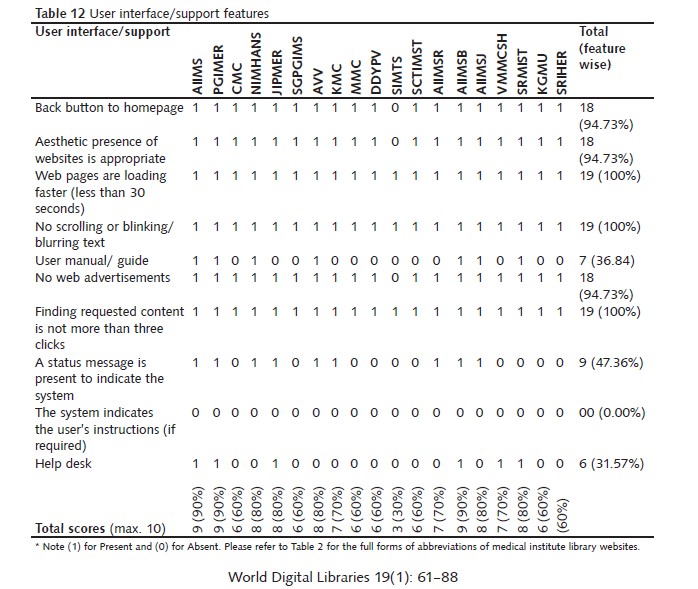 |
|
|
Table 13 presents the cumulative scores for the 19 medical institute library websites, derived from Tables 3–12. A five-point quantitative rating scale was developed to assess whether the evaluation checklist effectively fulfilled its dual objective: assigning meaningful numerical values to each feature and differentiating overall website quality among institutions with comparable scope and intent (Bharati and Madhusudhan 2019). The total possible score was 154 points, and the performance ranges were equally distributed as follows: 125–154: Excellent 94–124: Above average 63–93: Average 32–62: Below average 01–31: Needs improvement The results reveal significant variation, with scores ranging from 31 to 109. None of the institutions achieved the ‘excellent’ category. AIIMS ranked highest with 109 points (70.77%), followed by SRMIST (103; 66.88%) and PGIMER (98; 63.64%). KMC scored 93 (60.39%), which falls within the upper threshold of the ‘Average’ category. Mid-level performance was observed in institutions such as NIMHANS, AIIMSB, KGMU, AIIMSJ, and AIIMSR, reflecting moderate strengths but limited adoption of advanced Web 2.0 and search tools. Lower-performing institutions, including SIMTS, MMC, and SGPGIMS, demonstrated substantial gaps in multimedia integration, digital services, and interactive features. Table 13 highlights pronounced disparities in digital maturity, highlighting the need for systematic enhancement to ensure robust, accessible, and user-centred medical library web platforms. Table 14 presents the consolidated final ranking of the 19 medical institute library websites, derived from the cumulative scores in Table 13 across all evaluation parameters. Table 14 presents the overall ranking of the 19 medical institute library websites based on their total scores out of a maximum of 154 points. The websites are classified into four performance categories: ‘above average’, ‘average’, ‘below average’, and ‘needs improvement’, enabling a clear comparative assessment of institutional digital maturity. Notably, none of the evaluated websites achieved the ‘excellent’ category. Only three institutions were rated ‘above average’, 12 were in the average’ range, 3 were ‘below average’, and 1 was ‘needs improvement’, indicating a broad performance gap across institutions. AIIMS, New Delhi, secured the highest score (109), followed by SRMIST, Chennai (103), and PGIMER, Chandigarh (98), reflecting strong performance in content depth, navigation, usability, and interface design. The majority of institutions were placed in the ‘average’ category, demonstrating acceptable structural and functional standards but limited integration of advanced features such as Web 2.0 tools and enhanced search capabilities. Lower-ranked institutions exhibited deficiencies in interactivity, multimedia integration, and service visibility, while SIMTS, Chennai, recorded the lowest score (31), highlighting significant structural and functional shortcomings. The final rankings reveal considerable disparity in website quality and underscore the need for systematic modernization to achieve consistent, user-centred, and technologically robust medical library platforms. 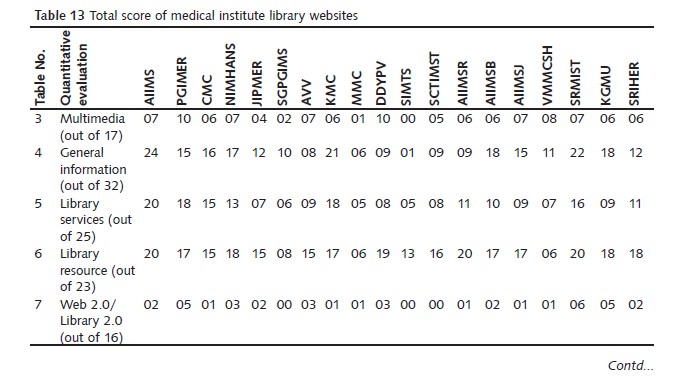 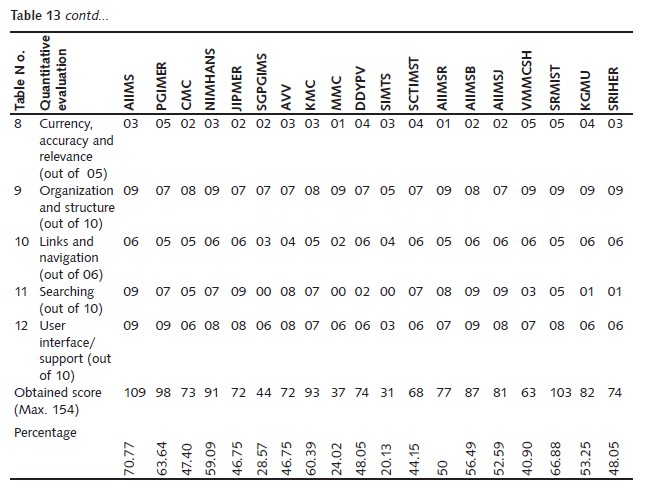 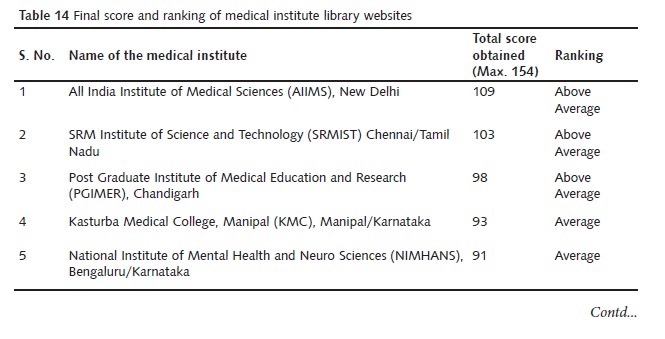 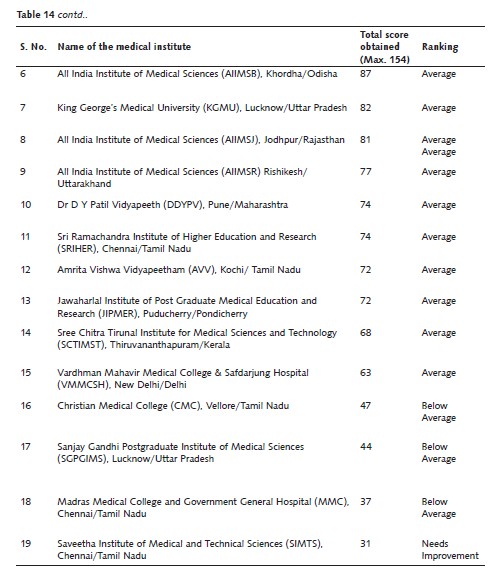 |
Conclusion |
|
The discussed study provides a comprehensive evaluation of medical institute library websites in India by examining both qualitative and quantitative dimensions, including multimedia features, content organization, navigation, search functionality, and user support. The findings reveal substantial variation in digital maturity across institutions. Most websites provide essential information and core library services; however, advanced features such as Web 2.0 tools, interactive tutorials, accessibility provisions for users with disabilities, and dynamic multimedia content remain limited or inconsistently implemented. Institutions such as AIIMS Delhi, SRMIST, Chennai, and PGIMER, Chandigarh demonstrate stronger alignment with contemporary web standards, while several others show notable gaps in functionality, usability, and accessibility. These differences indicate that many medical library websites have not yet developed into fully interactive, user-centred, and service-oriented digital platforms. The study has several implications. Theoretically, it contributes to library website evaluation research by applying a multi-dimensional assessment framework tailored to medical libraries. From a policy perspective, the findings highlight the need for institutional guidelines on website accessibility, content maintenance, and digital service quality. Practically, medical librarians can use the identified gaps to improve user engagement, online resource discoverability, and support services through better navigation, enhanced multimedia integration, Library 2.0 technologies, and regular content updating with clear revision indicators. Although the study is limited by its sample size and the evolving nature of website content, it establishes a useful benchmark for future evaluations and offers actionable directions for developing more accessible, technologically robust, and user-focused medical library web portals in India. |
References |
|
Aditia, A., R. Rahmi, and M. Buduroh. 2024. Evaluation of Universitas Indonesia Library website Using UX questionnaire and usability testing. ResearchGate. Details available at <https://www.researchgate.net/profile/Aditia-Aditia-2/publication/380401531_Evaluation_of_Universitas_Indonesia_Library_Website_Using_UX_Questionnaire_and_Usability_Testing/> Anyaoku, E., and L. A. Pract. 2020. Usability evaluation of university library websites in South-South Nigeria. Library Philosophy and Practice. Details available at <https://core.ac.uk/download/pdf/286730062.pdf> Berelson, B. 1952. Content Analysis in Communication Research. New York: Free Press Bharati, S. K., and M. Margam. 2019. Content evaluation of Jawaharlal Nehru University and Banaras Hindu University Library websites in India. Library Philosophy and Practice (e-journal). Details available at <https://digitalcommons.unl.edu/libphilprac> Brahma, K., and M. K. Verma. 2022. Web content analysis of national libraries’ websites in Asia: an evaluation. International Journal of Information Science and Management 20 (2): 27–42. Details available at <https://ijism.isc.ac/article_698377.html> Gohain, A. B., D. Mishra, and V. U. Mera. 2023. Content analysis of academic library websites with special reference to the central universities in northeast India. The Scientific Temper, 14 (4): 1426–1433. DOI: https://doi.org/10.58414/scientifictemper.2023.14.4.54. Krippendorff, K. 2008. A framework for content analysis. In: Content Analysis: An Introduction to Its Methodology, (2nd edition), pp. 211–240. Thousand Oaks, CA: Sage Publications Madhu, S., and B. U. Kannappanavar. 2024. Web presence and features of library websites/webpages of NIRF-ranked pharmacy institutes of south India: an evaluative study. DESIDOC Journal of Library and Information Technology, 44 (5): 317–324. DOI: https://doi.org/10.14429/DJLIT.44.05.18850. Madhusudhan, M., and N. Ahmed. 2013. Evaluation of Indian Institutes of Management Library websites in India. World Digital Libraries, 6 (1): 55–66 Rafiq, S., M. Ashiq, and S. Ur Rehman. 2021. A content analysis of the websites of the world’s top-50 universities in medicine. Journal of Library Administration, 61 (3): 260–281. DOI: https://doi.org/10.1080/0194262X.2021.1889446. Rahmandita, E. 2022. Evaluating university library websites in Indonesia and Malaysia. In: Proceedings of the 7th International Conference on E-Society, E-Education and E-Technology, pp. 107–112. DOI: https://doi.org/10.4108/eai.19-10-2021.2316602. Rekha, H., and M. Chandrashekara. 2020. Analysis of medical college websites in Kerala state using the content analysis method. International Journal of Latest Research in Engineering and Technology, Tella, A. 2022. Revitalizing the library through usability features of the university library websites. Journal of Electronic Resources Librarianship, 34 (1): 1–20. DOI: https://doi.org/10.1080/1941126X.2022.2028425. Tembo, D., A. Akakandelwa, and L. Phiri. 2023. Usability evaluation of university library portals in Zambia. In: Proceedings of the 25th International Conference on Asia-Pacific Digital Libraries, pp. 265–276. New York: ACM. DOI: https://doi.org/10.1145/3628096.3629083. Ullah, M. 2024. Content analysis of medical college library websites in Pakistan indicates necessary improvements. Health Information and Libraries Journal, 41 (1): 16–25. DOI: https://doi.org/10.1111/hir.12386 Yadav, M., and R. Mishra. 2021. Usability analysis of Indian Institutes of Science Education and Research (IISERs) Library websites: a study. Library Philosophy and Practice, 1 (15). Details available at <https://digitalcommons.unl.edu/libphilprac/9411. |