| World Digital Libraries: An International Journal (WDL) Vol.18(2) December 2025 Print ISSN : 0974-567X Online ISSN : 0975-7597 |
Academic Writing Tools: a systematic review of their influence on research using PRISMA |
Dr M. Madhusudhan Dr P. Pandey Dr B. P. Singh |
| DOI: 10.18329/09757597/2025/18207 |
Introduction |
|
Writing is both an art and a complex skill that integrates mental and physical processes. It reflects a close relationship between clear thinking and effective written expression (Akhtar, Hassan, Saidalvi, et al. 2019; Hyland, 2007). In academic contexts, writing takes a more defined form known as academic writing, which is commonly used in scholarly publications and educational settings. Academic writing is vital in research, marked by its structured presentation of ideas, evidence-based arguments, and logical reasoning (Khalifa and Albadawy 2024). Academic writing content has characteristics like formal, simple, clear, objective tone, focused, technical, impersonal, concise, logical, and well-structured (Chauhan 2022). Academic writing competencies play a vital role at the postgraduate level in communication, formulation, scholarship awards, evaluation processes, and assigning resources (Pérez-Fargallo, Marín-Restrepo, Diaz, et al. 2024). Academic writing skills are necessary for academic and professional uplift and achievement (Mondal and Mondal 2023). Writers invest comprehensive competency efforts in the facets, including composing content, organizing, studying purpose, critical thinking, academic wording, and grammar checking, with continuous maintenance of the format, referencing style, clarity, simplicity, conciseness and genre (Chauhan 2022). Writing a research paper is a tough task that requires a lot of time, effort, and skills (Mondal and Mondal 2023; Kallestinova 2011; Cortina 2023). Besides academic skills, language command is pivotal in expressing the ideas and concepts in academic content. Bhatt and Samanhudi (2022) found that language was the most common barrier to academic productivity. Akhtar, Hassan, Saidalvi, et al. (2019) determined the challenges in students’ attitudes towards English and language ability faced by English as a secondary language (ESL) students. In recent years, the incorporation of technology has played a significant role in the evolution of the academic landscape. Numerous digital writing assistant (DWA) tools are available for writers to do academic activities. DWAs are just like software packages available, either web-based or device-based, using artificial intelligence (AI) to assist with writing (Roe, Renandya, and Jacobs 2023). DWA tools help writers in the stage of the writing process, including taking notes, outlining, summarizing, mapping, drafting, citing, re-writing, editing, and many more (Schcolnik 2018). Not only writers, but academic writing tools (AWTs) driven by AI are becoming increasingly common in classrooms. The second-language writing teachers have rapidly adopted for the teaching-learning process for ESL and English as a Foreign Language (EFL) students (Javier 2022). With the vast development of technology, AI has become a game-changer, especially in natural language processing (NLP). The AI-embedded DWAs tools can achieve complete transposition and paraphrasing of text at the sentence level (Roe, Renandya, and Jacobs 2023). It can comprehend, translate, and produce human language, creating new opportunities for improving academic research and instruction. Researchers, teachers, and students actively seek resources for scholarly communication within the academic community. AI has aided the creation of numerous tools for content analysis, scientific writing, editing, and literature searches in the academic world. It makes it possible for students and scholars to produce excellent content quickly, and academic writing has revolutionized (Pinzolits 2023); however, authenticity, privacy, and the possibility of bias are crucial. Plagiarism detection tools, citation creation and reference management tools, grammar and spelling checkers, paraphrasing tools, and literature reviewing tools are categorized as tools that mainly support academic writing. The basic level of AWTs has been available for a long time; however, many AI-based AW tools have significant features for writers. A university library, a central hub of research and academic activities, must subscribe to and implement measures to support students, research scholars, academicians, and researchers to enhance academic productivity. Many studies have used distinguished research designs regarding academic writing and useful digital tools. Regarding systematic literature review (SLR) studies, Akhtar, Hassan, Saidalvi, et al. (2019) conducted a study to explore the challenges and solutions of English as an ESL students’ academic writing. Another review study conducted by Jarrah, Wardat, and Fidalgo (2023) focussed on the use of ChatGPT in academic writing and its implications regarding plagiarism. Mondal and Mondal (2023) explored the “use of ChatGPT in academic writing and provided insights on how to utilize it judiciously”. Roe, Renandya, and Jacobs (2023) conducted a review study on “implication of AI writing tools for academic integrity in language classroom.” Khalifa and Albadawy (2024) also systematically reviewed the literature published since 2019 on using AI in academic writing and research, highlighting it as a key tool for enhancing productivity. Various AI-based AWTs have emerged in recent years, and most depend on them. Therefore, it is essential to review prior literature systematically to track the list of AWTs, serving features of the tools, advantages, and challenges to use, and what the future trend is going on in selected literature using standard methods, that is, Preferred Reporting Items for Systematic Reviews and Meta-Analysis (PRISMA). |
Research questions (RQs) |
|
RQ1: What tools are commonly used in academic writing for research and scholarly activities? RQ2: How do different AWTs improve the quality and efficiency of academic and research work? RQ3: What are the benefits and challenges of AWTs for libraries and their users? RQ4: What are the emerging trends in AWTs for the future? |
Research Methodology |
|
The research adhered to PRISMA guidelines for this systematic literature review (SLR), which facilitates structured critical evaluation through planning, selection, extraction, and synthesis stages (Margam and Pandey 2025; Madhusudhan and Pandey, 2023; Shahzad, Khan, Javed, |
Planning stage |
|
During the planning stage, an initial search for ‘academic writing tools’ and ‘digital academic writing tools’ was conducted using Google Scholar, focusing on the first three pages and selecting just 12 articles from the Google Scholar interface to identify relevant and frequently cited articles. The abstracts and authors’ keywords were reviewed to develop an effective search strategy. This strategy incorporated primary keywords, synonymous terms, and phrases, ensuring that key terms reflected the main content themes to optimize document retrieval. The search strategy is as follows: ‘Academic writing tools’ OR ‘digital writing assistant’ OR DWA OR ‘AI tools’ OR ‘paraphrasing tools’ OR ‘reference management tools’ OR ‘citation generation tools’ OR ‘bibliograph* management tools’ OR ‘plagiarism detection tools’ OR ‘Grammarly’ OR ‘QuillBot’ OR ‘WordTune’ OR ‘Perspexility’ OR ‘ChatGPT’ OR ‘EndNote’ OR ‘Mendeley’ OR ‘Zotero’ OR ‘RefWorks’ OR ‘iThentic’ OR ‘DrilBit’ OR ‘Ourignal’ OR ‘Turnitin’ AND ‘librar’* AND ‘advantage’ OR ‘benefit’ OR ‘challenges’ OR ‘hinderance’. This strategy aims to comprehensively capture relevant literature while excluding specific topics outside the scope of our study. Instantly, inclusion and exclusion (Table 1) criteria with the discussion of the author and co-authors were undertaken. This study primarily emphasizes emerging technologies in academic writing. To ensure uniformity and consistency, only peer-reviewed journal articles were chosen. Owing to time constraints and the challenges of translating non-English papers, only articles published in English were included. Abstracts were used as a preliminary filter, as they provide a concise summary of the full paper, making it more efficient to assess relevance without reading the entire document. Papers with abstracts published between 2021 and 2024 were selected to evaluate the state of academic tools following the COVID-19 pandemic. 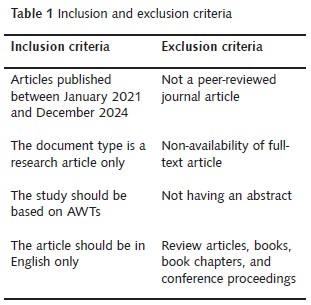 |
Conducting stage |
|
In this phase, ProQuest LISA and Scopus, both indexed in library and information science studies, were chosen from the extensive resources of the Delhi University Library System, which provides access to a variety of e-resources, including peer-reviewed journals, books, and conference proceedings. Scopus offers a broad range of multidisciplinary publications from reputable sources such as Emerald Insight, while ProQuest LISA focuses on scholarly content in library and information science. The document search commenced on 25 January 2025, using a carefully developed search string and the advanced search feature. Filters were applied based on inclusion and exclusion criteria, limiting the search to scholarly journal articles published in English between 2021 and 2024. This search resulted in 3,214 articles exported to EndNote Online in .ris format for further screening. |
Synthesis and screening stage |
EndNote reference management software (RMS) was used to identify and remove duplicate entries, eliminating 856 duplicates from the total dataset. This reduced the records to 2,358, then subjected them to title and abstract screening. After a thorough review, 2,283 records were excluded as they did not meet the study’s objectives and criteria. Of the remaining 75 records eligible for full-text access, only 62 were available for detailed reading. Data extraction from these articles was conducted using MS Excel, resulting in 40 articles being identified as fully relevant, with the rest excluded. The data were then organized and presented thematically (Figure 1).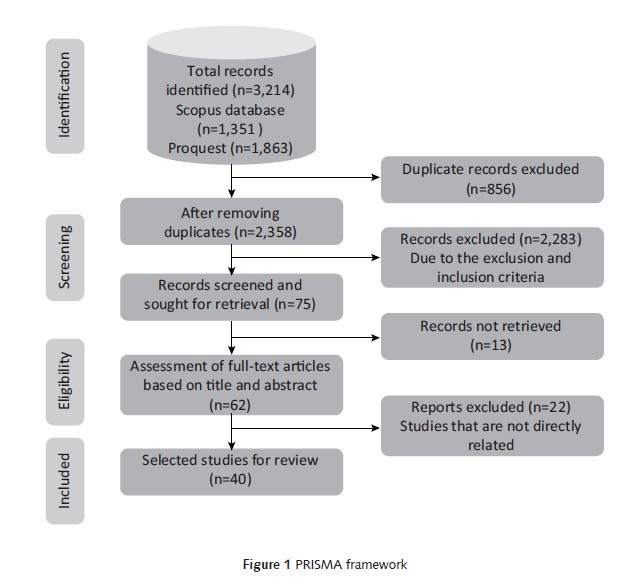 |
Risk of bias |
| To minimize bias, keywords were selected from highly cited papers in Google Scholar, and a comprehensive search string was created using author keywords and relevant synonyms. The search strategy was refined through discussions with the co-author(s) and applied to the databases using advanced search functions. Multiple search iterations were conducted with necessary adjustments to optimize results, finalizing the search strategy, filters, and recorded data. |
Data Analysis and Interpretation |
| Out of 3,214 records, only 40 studies were found to be relevant based on the study’s objectives. Data from these selected articles were extracted and recorded in an MS Excel sheet. A thorough review of these articles revealed various AWTs that support and enhance researchers’ and scholars’ productivity and academic quality. Those who utilize these tools can complete academic tasks more efficiently. Following an in-depth analysis of the full-text articles, key academic tools, their services, benefits, and drawbacks were identified. |
Academic writing tools |
|
The importance of academic writing tools, also known as digital writing assistants, continues to grow due to their substantial support in writing. Academic writing demands adherence to technicality, objectivity, impersonality, conciseness, logical flow, and clear organization. Writers must invest significant mental and physical effort, considering aspects like writing purpose, word choice, grammar, style, clarity, conciseness, and citation formats. While leveraging technological advancements can greatly enhance productivity, subscribing to these tools individually can be challenging. Thus, libraries must provide access to these tools for academic writers, researchers, scholars, and faculty. The rapid evolution of technology has led to the constant emergence of new tools designed for both operational and academic purposes. As centres of research and academic activity, university libraries incorporate AI-embedded technologies to streamline tasks. Despite ongoing debates regarding their use, language-generative AI tools have demonstrated notable effectiveness in academic work. These tools are primarily utilized for grammar and spell-checking, re-writing and paraphrasing, and managing citations and references. Advanced tools also support literature reviews during research activities. Based on a detailed review of selected studies, AWTs can be classified into three main categories listed in Table 2. 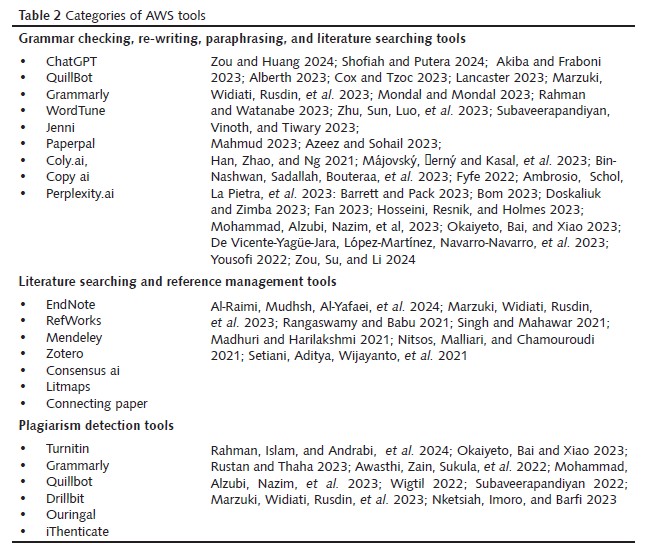 |
Services of academic writing tools |
|
Academic writing tools serve various specialized purposes. Writers must navigate several steps throughout their process, and these tools play a crucial role in enhancing content—both quality and quantity wise. Minimizing time-consuming and inefficient tasks helps writers focus on more productive activities. The specific functions of these tools are detailed below. Grammar checking, paraphrasing tools, and re-writing: These tools are particularly beneficial for non-native English speakers or those unfamiliar with other foreign languages. Academic writing follows distinct conventions, differing significantly from other forms of writing, and the text must adhere to academic standards. As such, these AI tools are mostly used in rewriting, paraphrasing, and translating words, phrases, and sentences, which are essential for writing academic content. Some of the tools are utilize for idea generation for their writing. Recently, tools like ChatGPT and Copilot have incorporated features for literature searches and content summarization, helping writers find and synthesize the necessary information. The ChatGPT support writers at the pre-writing, during-writing and post-writing stages and serve as a self-learning tool for writing and thinking development with its human and non-human features (Zou and Huang, 2024; Al-Raimi, Mudhsh, Al-Yafaei, et al. 2024; Akiba and Fraboni, 2023; Alberth, 2023; Cox and Tzoc, 2023; Lancaster, 2023; Marzuki, Widiati, Rusdin, et al., 2023; Mondal and Mondal, 2023; Rahman and Watanabe, 2023; Zhu, Sun and Luo2023; Subaveerapandiyan, Vinoth and Tiwary, 2023; Mahmud, 2023; Azeez and Sohail, 2023; Han, Zhao and Ng, 2021; Májovský, Černý Kasal, et al. 2023; Bin-Nashwan, Sadallah, Bouteraa, et al., 2023; Fyfe, 2022; Ambrosio, Schol, La Pietra, et al. 2023 ; Barrett and Pack, 2023; Bom, 2023; Doskaliuk and Zimba, 2023; Fan, 2023; Hosseini, Resnik, and Holmes, 2023; Mohammad, Alzubi, Nazim, et al. 2023; Okaiyeto, Bai and Xiao 2023; De Vicente-Yagüe-Jara, López-Martínez and Navarro-Navarro et al., 2023; Yousofi, 2022; Zou, Su and Li, 2024). |
Reference management tools |
|
Prior literature plays a crucial role in supporting academic statements and arguments. Collecting, organizing, and reviewing a large volume of literature during research and writing can be challenging to manage manually. In such cases, reference management tools are invaluable in facilitating literature management and reducing the risk of plagiarism. These tools help organize references, generate automatic citations, and quickly switch between citation styles. They also offer offline and online features like grouping, annotation, and tagging. Additionally, these tools allow users to access their accounts across multiple devices (Marzuki, Widiati, Rusdin, et al. 2023; Rangaswamy and Babu 2021; Singh and Mahawar 2021; Madhuri and Harilakshmi 2021; Nitsos, Malliari and Chamouroudi 2021; Setiani, Aditya, Wijayanto, et al. 2021). |
Plagiarism detection tools |
|
With the advancement of technology, the risk to academic integrity continues to grow. Individuals involved in academic activities often face plagiarism issues, whether knowingly or unknowingly. In some cases, errors in citation practices lead to unintentional plagiarism, even when there is no intent to steal another’s work. However, some individuals directly plagiarize by copying or rearranging others’ content. Tools designed to detect plagiarized material, including manuscript sources, are essential in addressing these issues. These tools play a critical role in maintaining academic integrity (Okaiyeto, Bai, and Xiao 2023; Rustan and Thaha 2023; Awasthi, Zain, Sukula, et al. 2022; Mohammad, Alzubi, Nazim, et al. 2023; Marzuki, Widiati, Rusdin, |
Advantages of using academic writing tools |
|
In recent years, academic research and work have increasingly relied on technology. Numerous tools and applications have been developed to enhance efficiency in this field, enabling global sharing of productive intellectual work. As a result, consistency and uniformity in language and formatting have become essential. Tools for re-writing and paraphrasing, plagiarism detection, and reference management have thus become invaluable aids for researchers and academicians. The following benefits, highlighted in recent literature, further emphasize the advantages of these tools for researchers: AWTs help improve writing skills. These tools like ChatGPT support writers pre-writing, during-writing and post-writing stages (Zou and Huang 2024; Alberth 2023; Fan 2023; Mohammad, Alzubi, Nazim, These tools can be easily adopted without requiring specific skills (Rangaswamy and Babu 2021; Nketsiah, Imoro, and Barfi 2023; Fyfe 2022; Madhuri and Harilakshmi 2021; Nitsos, Malliari, and Chamouroudi 2021; Setiani, Aditya, Wijayanto, et al. 2021; Hosseini, Resnik, and Holmes 2023; Okaiyeto, Bai, and Xiao 2023; Mondal and Mondal 2023; Mohammad, Alzubi, Nazim, et al. 2023). They foster critical thinking and idea generation by supporting smaller tasks (Mondal and Mondal 2023; Okaiyeto, Bai, and Xiao 2023; Zou, Su, and Li 2024; Zhu, Sun, Luo 2023; Cox and Tzoc 2023; Mohammad, Alzubi, Nazim, et al. 2023). These tools help maintain the quality of writing for experienced authors while improving text quality for novice researchers, as well as for EFL (English as a Foreign Language) or ESL (English as a Second Language) writers (Albert 2023; Fan 2023; Mahmud 2023; Han, Zhao, and Ng 2021; Zhu, Sun, and Luo 2023; Cox and Tzoc 2023; Mondal and Mondal 2023; Mohammad, Alzubi, Nazim, et al. 2023). They reduce the overall workload for writers or academic professionals (Cox and Tzoc 2023; Mahmud 2023; Han, Zhao, Ng 2021; Fyfe 2022; Madhuri and Harilakshmi 2021; Nitsos, Malliari, and Chamouroudi 2021; Setiani, Aditya, Wijayanto, et al. 2021; Okaiyeto, Bai, and Xiao 2023; Mondal and Mondal 2023; Mohammad, Alzubi, Nazim, These tools save valuable time by assisting with reference management, grammar, spelling checks, plagiarism detection, and research process for students and academic professionals (Shofiah and Putera 2024; Alberth 2023; Singh and Mahawar 2021; Mohammad, Alzubi, Nazim, et al. 2023; Mahmud 2023; Han, Zhao, and Ng 2021; Fyfe 2022; Barrett and Pack 2023; Madhuri and Harilakshmi 2021; Nitsos, Malliari, and Chamouroudi 2021; Setiani, Aditya, Wijayanto, et al. 2021; Marzuki, Widiati, Rusdin, et al. 2023; Rangaswamy and Babu 2021; Mondal and Mondal 2023). These tools become a supplementary tool to support the learning and research process (Shofiah and Putera 2024). |
Hindrances of academic writing tools |
|
The digital era, specifically AI, demands we embrace technology to complete routine tasks. Those with technophobia or a rejection attitude towards technology need help to keep up with their peers. Despite concerns over security and privacy, there is a rapid push to adopt the myriad of applications available in the market. Teaching and learning have increasingly transitioned to hybrid modes, with libraries expanding their collections of electronic resources to outpace print materials. This shift has led to an increased demand for user-centric content. Consequently, completing academic and research tasks without relying on technology has become challenging. While the previous section discussed various tools and technologies for academic and research work, several obstacles still need to be overcome in their adoption. Some of the challenges identified in the literature are outlined below: Bias and loss of originality: AI tools like ChatGPT, QuillBot, Grammarly, and WordTune, which rely on natural language processing, can introduce bias into the content. Additionally, when writers lack strong vocabulary skills, the originality, emotions, and ideas intended by the author can be obscured, potentially disrupting the coherence and depth of the writing (Alberth 2023; Mondal and Mondal 2023; Rahman and Watanabe 2023; Májovský, Černý, Kasal, et al. 2023). Issues of academic integrity: AI tools often aggregate content from various sources and can generate human-like text, which can blur the lines between original authorship and machine-generated content. This raises concerns about plagiarism, especially if AI-generated work is accepted without scrutiny. Even non-experts may try to publish AI-generated documents that are deemed plagiarized (Alberth 2023; Rahman and Watanabe 2023; Marzuki, Widiati, Rusdin, et al. 2023; Rustan and Thaha 2023; Mahmud 2023; Azeez and Sohail 2023; Han, Zhao, and Ng 2021; Májovský, Černý, Kasal, et al. 2023; Bin-Nashwan, Sadallah, Bouteraa, et al. 2023; Fyfe 2022; Ambrosio, Schol, La Pietra, et al. 2023; Wigtil 2022; Mohammad, Alzubi, Nazim, et al. 2023; Nketsiah, Imoro, Barfi 2023; Doskaliuk and Zimba 2023). Ethical concerns: Using AI tools for re-writing and paraphrasing content can be seen as a violation of academic ethics. Writers must develop the necessary skills to complete writing tasks independently without relying on AI tools to replicate human-like writing. Authentic scholarly communication requires both physical and mental engagement from the writer (Zou and Huang 2024; Rahman and Watanabe 2023; Subaveerapandiyan, Vinoth, and Tiwary 2023; Barrett and Pack 2023; Okaiyeto, Bai, and Xiao 2023; Azeez and Sohail 2023; Han, Zhao, and Ng 2021; Májovský, Černý, Kasal, et al. 2023; Bin-Nashwan, Sadallah, Bouteraa, et al. 2023; Barrett and Pack 2023; Wigtil 2022; Marzuki, Widiati, Rusdin, et al. 2023; Mohammad, Alzubi, Nazim, et al. 2023; Nketsiah, Imoro, and Barfi 2023; Doskaliuk and Zimba 2023). Loss of creativity and critical thinking: Overreliance on AI tools can stifle creativity and critical thinking. Writers who habitually use such tools may become dependent on them for generating new ideas, rather than relying on their cognitive abilities to create original content (Aljuaid 2024; Zou and Huang 2024; Shofiah and Putera 2024; Zhu, Sun, and Luo 2023; Rahman and Watanobe 2023; Subaveerapandiyan, Vinoth, and Tiwary 2023; Wigtil 2022; Azeez and Sohail 2023; Májovský, Černý, Kasal, et al. 2023; Han, Zhao, and Ng 2021; Barrett and Pack 2023; Lancaster 2023). Memory loss and learning loss: Tools that provide ready-made solutions with a simple click or search bar entry can reduce the need for writers to memorize vocabulary, citation styles, and other critical academic details. This lack of effort in recalling and storing such information can lead to decreased memory retention. These tools also support learning practices (Zou and Huang 2024; Mohammad, Alzubi, Nazim, et al. 2023; Azeez and Sohail 2023; Han, Zhao, and Ng 2021; Májovský, Černý, Kasal, et al. 2023; Bin-Nashwan, Sadallah, and Bouteraa, et al. 2023; Fyfe 2022; Ambrosio, Schol, La Pietra, et al. 2023; Okaiyeto, Bai, and Xiao 2023). Misuse: A strong academic foundation is necessary to detect errors in content generated by AI tools. There needs to be more justification for students below the postgraduate level to rely on these tools, especially since no global policy governs their use at this stage of academic development. However, many students are already turning to tools like ChatGPT to complete assignments, which raises concerns about the proper use of these technologies (Subaveerapandiyan, Vinoth, and Tiwary 2023; Mohammad, Alzubi, Nazim, et al. 2023; Bin-Nashwan, Sadallah, Bouteraa, et al. 2023; Fyfe 2022; Ambrosio, Schol, La Pietra, et al. 2023). Over-reliance: Including numerous features in AI tools can lead to an over-dependence on technology for even minor tasks. Writers may stop trying to learn grammar rules, memorize vocabulary, or understand citation and referencing systems. Additionally, these tools may discourage writers from engaging deeply with the original content. The persuasive digital marketing of such technologies contributes to this over-reliance, which may have long-term negative effects on academic development (Shofiah and Putera 2024; Alberth 2023; Rahman and Watanobe 2023; Marzuki, Widiati, Rusdin, et al. 2023; Madhuri and Harilakshmi 2021; Mahmud 2023; Azeez and Sohail 2023; De Vicente-Yagüe-Jara, López-Martínez, Navarro-Navarro, et al. 2023; Okaiyeto, Bai, and Xiao 2023; Mondal and Mondal 2023; Doskaliuk and Zimba 2023). |
Future Trends in Academic Writing Tools |
|
As technology evolves and academic needs shift, the future of AWTs is poised to become increasingly sophisticated and advanced. AI-powered tools can generate high-quality content and provide real-time feedback to improve readability and originality. These tools will integrate more with writing platforms, offering seamless access to essential writing tools. This will allow writers to effortlessly choose the tools they need, streamlining the writing process. Given that language is a medium for communication, future AWTs will prioritize linguistic diversity, ensuring that all languages are treated equally. These tools will support accurate translation and transformation, rendering content in different languages according to the author’s needs and providing more inclusive and effective communication. Plagiarism detection tools are expected to become more robust and capable of identifying even subtle, macro-level instances of plagiarism. As a result, the culture of maintaining academic integrity will strengthen, with many educational institutions offering plagiarism-checking services as part of their academic processes. These tools will improve the accuracy of plagiarism detection, further supporting researchers and writers in producing original work. Reference management tools will continue to evolve, offering better citation and bibliography generation for a wider range of local and international sources. With the increasing use of cloud-based RMS, writers will benefit from tools that can be accessed across multiple devices, offering greater flexibility. Additionally, these tools will develop user-friendly interfaces, incorporating feedback from authors to enhance their features and make them more intuitive. Given the diversity of academic writing genres, customization options will become more common. Writers can personalize their writing tools to suit their needs, whether for academic papers, theses, or articles. Plagiarism detection, reference management, and paraphrasing tools will likely be integrated into popular writing platforms, creating a comprehensive ecosystem for academic writing. The widespread adoption of mobile technology has made it easier to access AWTs on the go. However, typing long texts on small mobile screens is a tedious task. As a result, we can expect mobile versions of writing tools to become more efficient, with improved features to enable easier use on smartphones and tablets. With growing concerns about data privacy and security, future writing tools will strongly emphasize protecting the originality and confidentiality of authors’ content. Writers can expect these tools to offer enhanced security measures, ensuring that their data remains safe and their intellectual property is protected. |
Conclusion |
|
The comprehensive review of AWTs highlights their significant impact on modern academic practices. These tools, powered by AI, have transformed how researchers, students, and educators approach writing, making it more efficient, accurate, and accessible. The analysis highlights that AWTs such as grammar checkers, paraphrasing tools, plagiarism detectors, and reference managers enhance writing quality and support scholars in producing high-standard academic work. However, despite these advantages, the study emphasizes notable challenges, including over-reliance, ethical dilemmas, potential loss of originality and creativity, and issues related to data privacy. These hindrances indicate that while AWTs provide valuable assistance, they should be used judiciously and complementarily to human intellectual effort rather than as replacements. Looking ahead, the future of AWTs is set to evolve with more sophisticated features, including enhanced real-time feedback, stronger integration with writing platforms, and improved data security. The role of academic institutions and libraries remains critical in facilitating access to these tools and providing training to ensure their responsible use. This balance between technological advancement and ethical, mindful application is crucial for maintaining academic integrity and fostering genuine scholarly development. This study highlights the extensive use of academic writing tools by writers, researchers, and faculty, although it is constrained by the specific studies selected under PRISMA guidelines. Future research should broaden the exploration of these tools using varied methods, additional databases, and different thematic perspectives. |
References |
|
Al-Raimi, M., B. A. Mudhsh, Y. Al-Yafaei, and S. Al-Maashani. 2024. Utilizing artificial intelligence tools for improving writing skills: Exploring Omani EFL learners' perspectives. Forum for Linguistic Studies 6 (2): 1–14. DOI: https://doi.org/10.59400/fls.v6i2.1177 Akhtar, R., H. Hassan, A. Saidalvi, and S. Hussain. 2019. A systematic review of the challenges and solutions of ESL students' academic writing. International Journal of Engineering and Advanced Technology 8 (5): 1169–1171. DOI: 10.35940/ijeat.E1164.0585C19 Akiba, D. and M. C. Fraboni. 2023. AI-supported academic advising: Exploring ChatGPT's current state and future potential toward student empowerment; Education Sciences 13 (9): 885. DOI: https://doi.org/10.3390/educsci13090885 Alberth. 2023. The use of ChatGPT in academic writing: a blessing or a curse in disguise? TEFLIN Journal: a publication on the teaching and learning of English 34 (2): 337–352. Details available at <10.15639/teflinjournal.v34i2/337-352> Ambrosio, L., J. Schol, V. A. La Pietra, F. Russo, G. Vadalà, and D. Sakai. 2024. Threats and opportunities of using ChatGPT in scientific writing: the risk of getting spineless. JOR Spine 7 (1). DOI: https://doi.org/10.1002/jsp2.1296 Ashiq, M. and N. F. Warraich. 2023. A systematized review on data librarianship literature: current services, challenges, skills, and motivational factors. Journal of Librarianship and Information Science 55 (2): 414–433. DOI: https://doi.org/10.1177/09610006221083 Awasthi, S., M. I. M. Zain, and S. K. Sukula. 2022. Understanding the usage of anti-plagiarism software: lessons from Malaysian communities. Library Philosophy and Practice, (e-journal) 7139. Details available at <https://digitalcommons.unl.edu/libphilprac/7139> Azeez, M. A. and S. S. Sohail. 2023. Correspondence to the role of ChatGPT in scholarly editing and publishing. European Science Editing 49: e113445. DOI: https://doi.org/10.3897/ese.2023.e113445 Barrett, A. and A. Pack. 2023. Not quite eye to AI: student and teacher perspectives on the use of generative artificial intelligence in the writing process. International Journal of Educational Technology in Higher Education 20 (1): 59. DOI: https://doi.org/10.1186/s41239-023-00427-0 Bhatt, I. and U. Samanhudi. 2022. From academic writing to academics writing: transitioning towards literacies for research productivity. International Journal of Educational Research 111: 101917. DOI: https://doi.org/10.1016/j.ijer.2021.101917 Bin-Nashwan, S. A., M. Sadallah, and M. Bouteraa. 2023. Use of ChatGPT in academia: academic integrity hangs in the balance. Technology in Society 75: 102370. DOI: https://doi.org/10.1016/j.techsoc.2023.102370 Bom, H. S. H. 2023. Exploring the opportunities and challenges of ChatGPT in academic writing: a roundtable discussion. Nuclear Medicine and Molecular Imaging 57 (4): 165–167. DOI: https://doi.org/10.1007/s13139-023-00809-2 Chauhan, P. 2022. Fundamentals of academic writing: a literature review. Journal of NELTA 27 (1–2): 161–180. DOI: https://doi.org/10.3126/nelta.v27i1-2.53201 Cortina, M. S. 2023. The why, what, and how of publishing a manuscript: a blend of art and science. Indian Journal of Ophthalmology 71 (8): 2930–2931. Details available at <10.4103/IJO.IJO_1930_23> Cox, C., and E. Tzoc. 2023. ChatGPT: implications for academic libraries. College and Research Libraries News 84 (3): 99. DOI: https://doi.org/10.5860/crln.84.3.99 De Vicente-Yagüe-Jara, M. I., O. López-Martínez, V. Navarro-Navarro, and F. Cuéllar-Santiago. 2023. Writing, creativity, and artificial intelligence. ChatGPT in the university context. Comunicar: media education research journal 31 (77): 45–54. DOI: https://doi.org/10.3916/c77-2023-04 Doskaliuk, B. and O. Zimba. 2023. Beyond the keyboard: academic writing in the era of ChatGPT. Journal of Korean Medical Science 38 (26). DOI: https://doi.org/10.3346/jkms.2023.38.e207 Fan, N. 2023. Exploring the effects of automated written corrective feedback on EFL students' writing quality: a mixed-methods study. SAGE Open 13 (2). DOI: https://doi.org/10.1177/21582440231181296 Fyfe, P. 2022. How to cheat on your final paper: assigning AI for student writing. AI & Society 38 (4): 395–1405. DOI: https://doi.org/10.1007/s00146-022-01397-z Han, Y., S. Zhao, and L. L. Ng. 2021. How technology tools impact writing performance, lexical complexity, and perceived self-regulated learning strategies in EFL academic writing: a comparative study. Frontiers in Psychology 12. DOI: https://doi.org/10.3389/fpsyg.2021.752793 Hosseini, M., D. B. Resnik, and K. Holmes. 2023. The ethics of disclosing the use of artificial intelligence tools in writing scholarly manuscripts. Research Ethics Review 19 (4): 449–465. DOI: https://doi.org/10.1177/174701612311804 Hyland, K. 2007. Genre pedagogy: language, literacy, and L2 writing instruction. Journal of Second Language Writing 16 (3): 148–164. DOI: https://doi.org/10.1016/j.jslw.2007.07.005 Jarrah, A. M., Y. Wardat, and P. Fidalgo. 2023. Using ChatGPT in academic writing is (not) a form of plagiarism: what does the literature say? Online Journal of Communication and Media Technologies 13 (4), e202346. DOI: https://doi.org/10.30935/ojcmt/13572 Javier, D R. 2022. App review using tech tools for academic writing: 'Grammarly' as a pedagogical tool. MEXTESOL Journal Kallestinova, E. D. 2011. How to write your first research paper. The Yale Journal of Biology and Medicine 84 (3): 181–190. PMID: 21966034 Khalifa, M, and M. Albadawy. 2024. Using artificial intelligence in academic writing and research: an essential productivity tool. Computer Methods and Programs in Biomedicine Update 100145: 1:11. DOI: https://doi.org/10.1016/j.cmpbup.2024.100145 Lancaster, T. 2023. Does digital watermarking offer a solution for artificial intelligence, text generation tools, and ChatGPT? International Journal for Educational Integrity 19 (10). DOI: https://doi.org/10.1007/s40979-023-00131-6 Madhuri, A J. 2021. Use and awareness of reference management software tools by research scholars of library and information science in India: a study. Library Philosophy and Practice 6371. Details available at <https://digitalcommons.unl.edu/libphilprac/6371> Madhusudhan, M. and P. Pandey. 2023. Innovative horizons: a systematic review of emerging technologies transforming library services. World Digital Libraries 16 (2): 119–134. Details available at <10.18329/09757597/2023/16209> Margam, M. and P. Pandey. 2025. Exploring excellence: a comprehensive examination of professional development in library and information science. Information Discovery and Delivery. DOI: https://doi.org/10.1108/IDD-02-2024-0017 Mahmud, F. A. 2023. Investigating EFL students' writing skills through artificial intelligence: Wordtune application as a tool. Journal of Language Teaching and Research 14 (5): 1395–1404. DOI: https://doi.org/10.17507/jltr.1405.28 Májovský, M., M. Černý , M. Kasal, M. Komarc, and D. Netuka. 2023. Artificial intelligence can generate fraudulent but authentic-looking scientific medical articles: pandora's box has been opened. JMIR. Journal of Medical Internet Research/Journal of Medical Internet Research 25: e46924. DOI: https://doi.org/10.2196/46924 Marzuki, U. W., D. Rusdin, Darwin, and I. Indrawati. 2023. The impact of AI writing tools on the content and organization of students' writing: EFL teachers' perspective. Cogent Education 10 (2). DOI: https://doi.org/10.1080/2331186x.2023.2236469 Mohammad, T., A. A. Alzubi, M. Nazim, and S. I. Khan. 2023. EFL paraphrasing skills with QuillBot: unveiling students' enthusiasm and insights. Journal of Pedagogical Research 7 (5): 359–373, EJ1411996 Moher, D., A. Liberati, J. Tetzlaff, D. G. Altman, D. Altman, G. Antes, and P. Tugwell. 2009. Preferred reporting items for systematic reviews and meta-analyses: the PRISMA statement (Chinese edition). Journal of integrative medicine 7 (9): 889–896. DOI: https://doi.org/10.3736/jcim20090918 Mondal, H. and S. Mondal. 2023. ChatGPT in academic writing: Maximizing its benefits and minimizing the risks. Indian Journal of Ophthalmology 71 (12): 3600–3606. DOI: 10.4103/IJO.IJO_718_23 Nitsos, I., A. Malliari, and R. Chamouroudi. 2021. Use of reference management software among postgraduate students in Greece. Journal of Librarianship and Information Science 54 (1): 95–107. DOI: https://doi.org/10.1177/0961000621996 Nketsiah, I., O. Imoro, and K. A. Barfi. 2023. Postgraduate students' perception of plagiarism, awareness, and use of Turnitin text-matching software; Accountability in Research: 1–17. DOI: https://doi.org/10.1080/08989621.2023.2171790 Okaiyeto, S. A., J. Bai, J, and H. Xiao. 2023. Generative AI in education: to embrace it or not? International Journal of Agricultural and Biological Engineering 16 (3): 285–286 Pérez-Fargallo, A., L. Marín-Restrepo, M. Diaz, and J. A P. Arcas. 2024. Limitations in the academic writing process of postgraduate students between 2010 and 2020. What tools do we have? In: Teaching Innovation in Architecture and Building Engineering: challenges of the 21st century, pp. 615–629. Cham: Springer Nature Switzerland. Pinzolits, R. 2023. AI in academia: An overview of selected tools and their application areas; MAP Education and Humanities 4 (1): 37–50. DOI: https://doi.org/10.53880/2744-2373.2023.4.37 Rahman, M. M. and Y. Watanobe. 2023. ChatGPT for education and research: Opportunities, threats, and strategies. Applied Sciences 13 (9): 5783. DOI: https://doi.org/10.3390/app13095783 Rahman, H., M. S. Islam, S. M. H. Andrabi, J. P. Sharma, and N. Reza. 2024. Comparing the similarity index across iThenticate, Ouriginal, and Turnitin plagiarism detection software. Journal of Physical Education and Sport 24 (2): 419–424 Rangaswamy, B. and R. Babu. 2021. Researcher's perception on Zotero and Mendeley reference management tools: a study. Library Philosophy and Practice (e-journal),5935. DOI: https://digitalcommons.unl.edu/libphilprac/5935 Roe, J., W. A. Renandya, and G. M. Jacobs. 2023. A review of AI-powered writing tools and their implications for academic integrity in the language classroom; Journal of English and Applied Linguistics 2 (1): 23-30. DOI: https://doi.org/10.59588/2961-3094.1035 Rustan, E. and H. Thaha. 2023. Decreased plagiarism behavior in academic writing by using reflective writing. International Journal of Society, Culture and Language Schcolnik, M. 2018. Digital tools in academic writing? Journal of Academic Writing 8 (1): 121–130. DOI: https://doi.org/10.18552/joaw.v8i1.360 Setiani, N., B. R. Aditya, I. Wijayanto, and A. Wijaya. 2021. A study on awareness of bibliographic management software for the academic writing activity in higher education. Journal of Physics: conference series 1823 (1): 1–6. DOI: https://doi.org/10.1088/1742-6596/1823/1/012035 Shahzad, K., S. A. Khan, Y. Javed, and A. Iqbal. 2023. E-learning for continuing professional development of university librarians: a systematic review. Sustainability 15 (1): 849. DOI: https://doi.org/10.3390/su15010849 Shofiah, N. and Z. F. Putera. 2024. Examining the user experience of artificial intelligence tools in academic writing: the perceptions of lecturers' practices (Preprint), pp. 1–24 DOI: https://doi.org/10.21203/rs.3.rs-3871916/v1 Singh, A. K. and K. L. Mahawar. 2021. Awareness of reference management software among the research scholars of Babasaheb Bhimrao Ambedkar University and Mahatma Gandhi Central University; Library Philosophy and Practice (e-Journal): 5589. Details available at <https://digitalcommons.unl.edu/libphilprac/5589> Subaveerapandiyan, A. 2022; Plagiarism software is a creator or destroyer for effective writing; DESIDOC Journal of Library and Information Technology 42 (2), 114–118. Details available at <https://philarchive.org/archive/SUBPSI-2> Subaveerapandiyan, A., A. Vinoth, and N. Tiwary. 2023. Netizens, academicians, and information professionals' opinions about AI with special reference to ChatGPT. Library Philosophy and Practice (e-Journal), 7596. Details available at <https://digitalcommons.unl.edu/libphilprac/7596> Wigtil, A. 2022. Is there a place for 'plagiarism detection software' in an academic library? Public Services Quarterly 18 (2): 129–135. DOI: https://doi.org/10.1080/15228959.2022.2044969 Yousofi, R. 2022. Grammarly deployment (in) efficacy within EFL academic writing classrooms: an attitudinal report from Afghanistan. Cogent Education 9 (1): 2142446. DOI: https://doi.org/10.1080/2331186x.2022.2142446 Zhu, C., M. Sun, J. Luo, T. Li, and M. Wang. 2023. How can we harness the potential of ChatGPT in education? Knowledge Management and E-Learning 15 (2): 133–152. DOI: https://doi.org/10.34105/j.kmel.2023.15.008 Zou, M. and L. Huang. 2024. The impact of ChatGPT on L2 writing and expected responses: voice from doctoral students. Education and Information Technologies 29(11): 13201–13219 Zou, X., P. Su, L. Li, and P. Fu, P. 2024 AI-generated content tools and students' critical thinking: insights from a Chinese university. IFLA Journal 50 (2): 228–241. DOI: https://doi.org/10.1177/03400352231214963 |