| World Digital Libraries: An International Journal (WDL) Vol.10(2) December 2017 Print ISSN : 0974-567X Online ISSN : 0975-7597 |
Role of NISCAIR in Professional Development on Digital Libraries |
Vijendra Kumar: Junior Research Fellow, Department of Library and Information Science, Vardhaman Mahaveer Open University, Kota 324021, India Dinesh K Gupta: Professor, Department of Library and Information Science, Vardhaman Mahaveer Open University, Kota 324021, India; (E): dineshkumargupta@vmou.ac.in |
| DOI: 10.18329/09757597/2017/10210 |
Introduction |
|
Today’s information arena is replete with opportunities to find, organize, transmit, share, and publish information in the preferred manner as desired by the user. The digital resources in libraries are even replacing the printed volumes which pose a managerial challenge for libraries and (library) professionals. The concept of digital libraries has become a reality in present times. Library and information professionals are supposed to manage digital content which is available in different forms and formats. However, digital libraries have been unsustainable due to many reasons, including lack of education and training avenues for the new and working professionals.1 The need to improve competencies and digital library skills is being emphasized in library and information science (LIS) literature. In present times, no doubt, there have been some initiatives for training library and information professionals on digital library technologies and tools; these include short-term training courses, seminars, workshops, and conferences. Such initiatives have been undertaken by institutions, such as The Energy and Resources Institute, New Delhi; Information and Library Network Centre (INFLIBNET),Gandhinagar; IIM Kozhikode; Documentation Research and Training Centre (DRTC), Bangalore; NCSI-IISc, Bangalore; Defence Scientific Information and Documentation Centre-DRDO (DESIDOC), New Delhi, CSIR-NISCAIR, New Delhi, for organizing various types of continuing professional education programmes to improve competencies and digital library skills of LIS professionals.2 The CSIR-National Institute of Science Communication and Information Resources (CSIR-NISCAIR) is one of the leading institutes, contributing towards bringing newer skills to manage libraries in general and developing digital libraries, in particular. At present, CSIR-NISCAIR is primarily providing training in various areas of information and communication technology (ICT) applications in libraries using open source softwares. It is pertinent to note at this juncture that digital libraries forms one of the focus areas of CSIR-NISCAIR training. This article explores the role of CSIR-NISCAIR with regard to professional development activities in digital libraries. |
Objectives |
|
Methodology |
|
Data has been collected from primary sources, such as annual reports, training course calendars, training brochures, prospectus of the training courses3of the Education and Training Division (ETD), CSIR-NISCAIR, New Delhi. The data have been analysed and presented through different tables and figures. |
Limitations |
|
The study is, however, limited to exploring short-term training courses on digital libraries, conducted by CSIR-NISCAIR during the session 2010–11 to 2015–16. It was intended to make a study of all the programmes conducted on digital libraries (DLs) by NISCAIR. However, due to non-availability of data, the time is restricted to the above-mentioned period. |
CSIR-NISCAIR: A Short History |
|
During the Second World-War, the government of India began to take interest in development of scientific research in the country and consequently, setup a bureau for scientific and industrial activities, the fore-runner of the Council of Scientific and Industrial Research (CSIR) in 1942. After the country attained independence in 1947, scientific research received further impetus in the growth in a number of science-based—societies, literature, and journals, etc. The Government of India evinced keen interest in developing documentation and information services as a necessary infrastructure support for research and development (R&D) activities. The most significant development in the Indian scene of documentation in the early fifties was establishment of the Indian National Scientific Documentation (INSDOC) at New Delhi in 1952 by the Government of India in cooperation with UNESCO in order to provide the complete range of documentation services to the existing and projected national laboratories, scientific and technological institutions, universities, industries, and so on.4 The National Institute of Science Communication and Information Resources (NISCAIR) came into existence on September 30, 2002, with the merger of the National Institute of Science Communication (NISCOM) and Indian National Scientific Documentation Centre (INSDOC). Both NISCOM and INSDOC, the two premier institutes of the Council of Scientific and Industrial Research (CSIR), were devoted to dissemination and documentation of science and technology (S&T) information.5 |
Professional Development Activities of NISCAIR: A Review |
|
The CSIR-National Institute of Science Communication and Information Resources has been playing a vital role in education and training for library and information management since the past six decades. CSIR-NISCAIR has been conducting human resource development programmes to educate and prepare LIS professionals, science communicators, and R&D personnel to meet the challenges of current times. Currently, NISCAIR is providing two types of HRD programmes—(i) short-term training courses and (ii) on-site training courses. These short-term training programmes are for in-service library professionals and persons interested in the field of LIS. The duration of the major programmes ranges from one to two weeks.6 With the increasing demand of qualified and trained professionals to manage the growing explosion of information, library and documentation centers and the training of LIS professionals assumes importance. INSDOC (now NISCAIR) initiated the AIS course in 1964 for provision of a more meaningful and efficient documentation and information service in the new context.7 Rajan (1983)8examined curriculum development of the INSDOC training course of Associateship in Information Science during 1980s. He mentioned about the emerging information institutions in India and efforts to developing the required manpower to organize and manage information services in the changing context. Anand and Sen (1991)9also studied INSDOC’s training courses during the years 1987 and 1990 wherein INSDOC organized eight short-term training courses of four weeks duration each, training 120 candidates during the period. The course content was also analysed. Participants included working librarians, information specialists, and teachers of LIS schools. Mahesh et al. (2010)10focused on importance of short-term training programmes on LIS in India and mentioned NISCAIR as one of the national-level institutes in the country, with the mandate and expertise for conducting training courses and wherein short-term training in LIS was concentrated. As its mandate that to carry out training activities, NISCAIR started conducting training on many open source software, such as DSpace, GSDL, NewGenLib, and so on. They highlighted that short term courses are a necessary component in the education system and these programmes fulfilled the continuing education needs of the society. Mahesh and Gupta (2010)11presented an overview of all the libraries of Council of Scientific and Industrial Research (CSIR) and focussed on human resource development programmes with various activities of INSDOC and mentioned that INSDOC, which is housed in the National Science Library, conducts training programmes that lead to an Associateship in Information Science. Harake and Hadagali (2016)12highlighted the importance of continuing education programmes for the library and information science professionals. They mentioned that NISCAIR, INFLIBNET, IASLIC, ICSSR are conducting short-term and long-term training programmes on various aspects in the field of library and information science. These were identified as the most interesting areas of training on IT and its related aspects like, LIS software, applications of IT, Internet and its applications, web based services, database management, and so on. |
Digital Libraries Development at NISCAIR |
|
The university–industry interaction has always been emphasized for quality outputs of the higher education system. CSIR-NISCAIR undertook many projects for development of DLs in order to establish its credibility in the development of professionals in DLs. The important DL-related projects/activities are as follows:
|
NISCAIR and its professional development activities |
|
The first time in-service training course in 1901–06 in India was initiated by John Macfarlane, the first librarian of National Library of India (earlier Imperial Library). The training programme was, however, only meant for other library staff and interested LIS professionals. Thereafter, in 1911,Siyaji Rao Gaikwad initiated the first training school in library education in India.18 The enormous changes that were to come in the library and information field alter its complexion were in evidence to some extent right in early sixties. The realization that new skills and technologies were needed to handle and disseminate information dawned upon those involved. At the same time, many of the established library schools in the country were found to be slow in introducing new programmes to suit the changing requirements. The decision was taken in the conference of information scientists convened by CSIR at Mysore in 1963 towards the need for training on documentation and information management and recommended that INSDOC be entrusted with the responsibility of conducting a regular training course for information professionals. Thereafter, INSDOC began a full-time training course leading to award of Associateship in Information Science in 1964. The objectives of this course were to train personnel and equip them with necessary skill and technical know-how to plan, organize, manage, control, supervise, and evaluate documentation and information services in R&D, industrial, and other cognate establishments.10 Equipped with the necessary facilities and manpower, NISCAIR is ideally placed to train and prepare science communicators, R&D personnel, and library and information professionals to meet the challenges of current times.19 Education and training programmes of NISCAIR include:
The AIS course of NISCAIR initiated in 1964, however, was discontinued in 2012 due to some policy issues and internal matters. Thereafter, NISCAIR has been conducting short-term training courses of one week/two weeks/one month regularly on different aspects of LIS.Table 1 mentions broad areas of the programmes conducted in recent years. 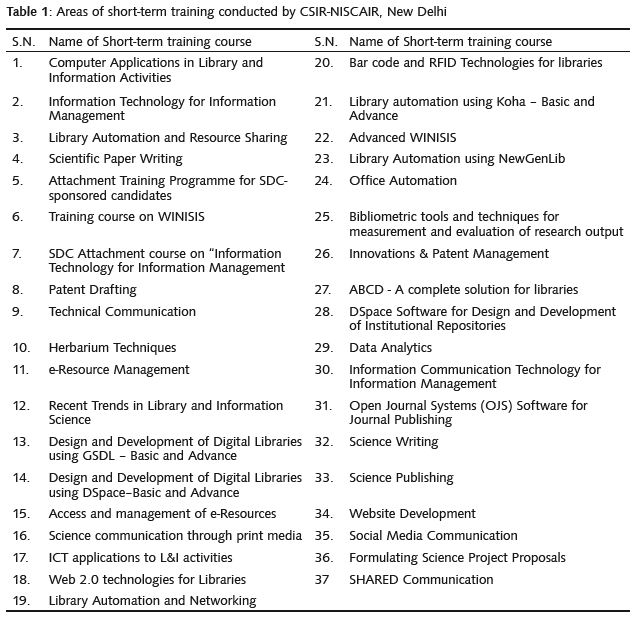 It has been envisaged that the training for library automation, ICT applications, science communication, and digital libraries have been the main focus of the programmes. More importantly, exposure to the newer applicable softwares, mainly OSS, has been included in the training offered by CSIR-NISCAIR during 2002–16. |
Discussion |
|
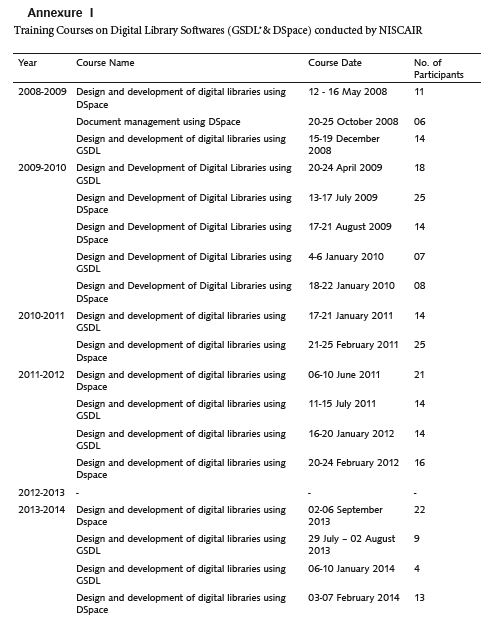
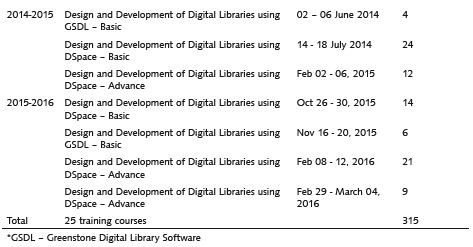
Since 2002, NISCAIR conducted 186 training courses and trained 2,425 LIS professionals. Every year, the ETD selects the training areas and courses to be offered. Table 2 provides details of the training courses and participants year-wise and also offers details of courses related to DLs. 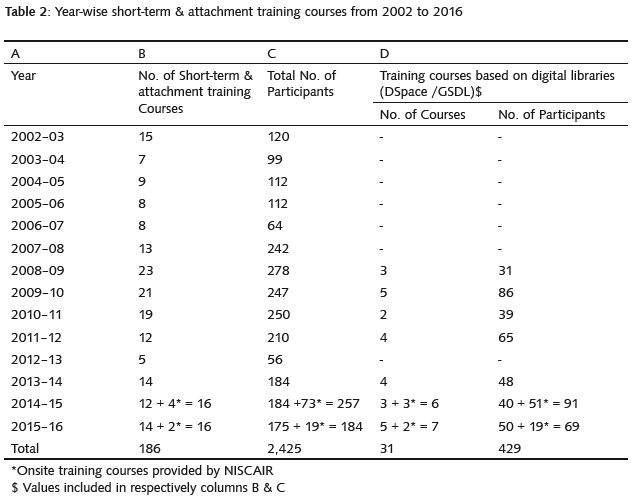 Table 2 also shows how short-term training on digital libraries (DSpace & GSDL) began in2008. From 2008 to 2016, NISCAIR conducted 31 training courses on DLs and trained 429 professionals for the same. This is inclusive of 5 courses conducted onsite for students of Certificate Programme on Digital Libraries (CPDL) of VMOU, Kota. Detailed information about short-term training courses on digital library softwares (GSDL & DSpace) conducted by NISCAIR from 2008 to 2016 at its premises at New Delhi have been reproduced in Annexure I. It shows that 315 participants have been trained in 25 short-term training courses on digital library. |
Short-term training programmes at NISCAIR Campus |
|
Table 3 presents information about the programmes conducted and participants from 2010 to 2016. 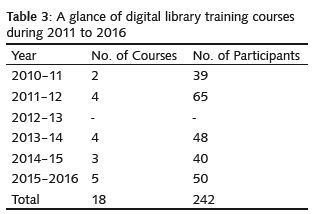 The table also shows that NISCAIR has prepared 242 human resources through 18 short-term training courses on digital libraries (GSDL & DSpace) during the period of the study from the session 2010–11 to 2015–16. The maximum number of courses (5) was conducted during 2015–16 but maximum number of participants (65) was trained during 2011–12. 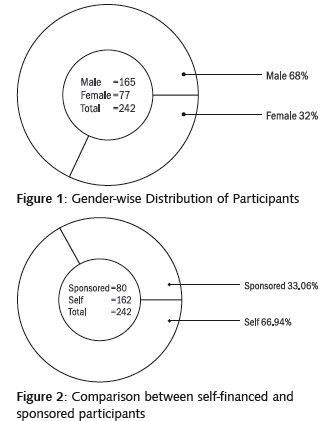 Figure 1 shows the gender-wise distribution of the participants, trained in short-term training courses on digital libraries (GSDL & DSpace) from the session 2010–11 to 2015–16 conducted by NISCAIR. As is visible, the majority was male participants (165; 68 per cent) and female participants comprised only 32 per cent (77). Figure 2 shows the category of the participants who self-financed or were sponsored by her/his institution/organization/university. The figure indicates that maximum participants (66.94 per cent; 162) were self financed and 33.05 per cent (80) participants were sponsored by her/ his institution/organization/university. The participation in the programme remained from all over the country. Figure 3 indicates the number of participants from respective states in the country. 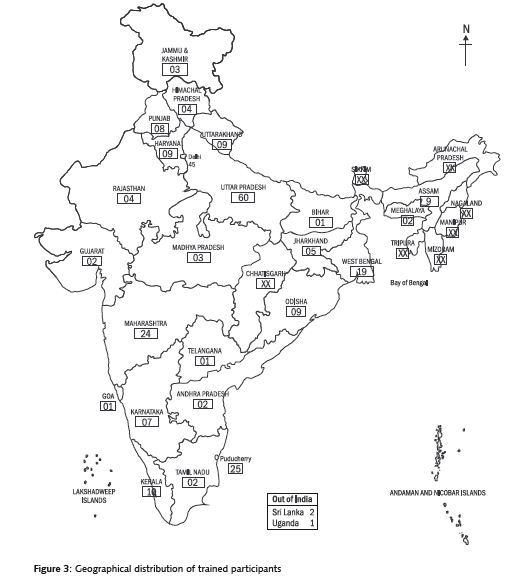 Figure 3 also shows the geographical distribution of the training participants through short-term training courses on digital libraries (GSDL & DSpace) during the session 2010–11 to 2015–16. It shows that 239 participants (out of 242)hailed from different states of the country and three participants were from abroad, two participants from Sri Lanka, and one was from Uganda. Participants from Utter Pradesh (54), Delhi (45), and Maharashtra (24) remained highest during the period of the study. |
On-site training programmes |
|
It has been discussed that NISCAIR is conducting on-site training courses as well as per demand from other institutions/organizations. NISCAIR has conducted five times one-week on-site short-term training courses on ‘Design and Development of Digital Libraries using GSDL and DSpaceat the Vardhman Mahaveer Open University (VMOU), Kota (Regional Center, Jaipur, and Kota) during the years 2014 to 2016. VMOU is a state open university, established by an Act of the Rajasthan Legislative Assembly in 1987 and is inclusive of DLIS, BLIS, MLIS, M.Phil (discontinued in 2011), and doctoral programmes. The Certificate Programme on Digital Libraries (CPDL) was initiated in 2014 as a six month programme and NISCAIR offers practical training to the students of CPDL at Regional Center Jaipur, and Kota. The six-day training includes an introduction to both GSDL and DSpace softwares which are useful for DLs. Table 5 provides details of the numbers of students attending the training programme of NISCAIR as part of CPDL programme of VMOU. 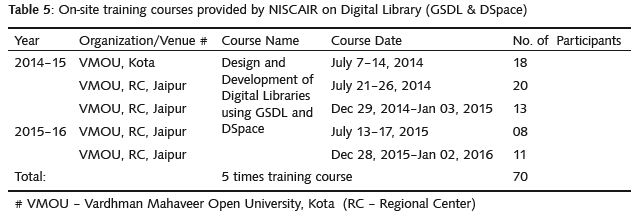 Table 5 indicates that in all, 70 participants attended training at VMOU during three years. This arrangement has been a constant feature and induction of DL concept at the student level, may be beneficial in establishing DLs in their career at a later stage. |
Course Contents of Short-term Courses on digital libraries |
|
As discussed earlier, NISCAIR has been continually conducting short-term training programmes on DLs, majorly comprising two DL softwares—Greenstone Digital Library Software (GSDL) and DSpace. 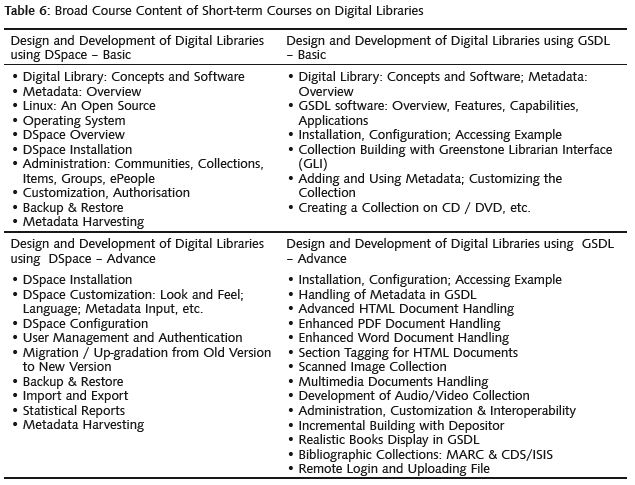 Table 6 enumerates the broad course contents of basic and advanced programmes on “Design and Development of Digital Libraries using GSDL and DSpace”. |
Conclusion |
|
Education and training has been extremely significant for the continuing professional development of LIS experts. CSIR-NISCAIR has been conducting many short-term training courses for LIS professionals in India since the past six decades. NISCAIR has also been providing certain short-term training courses on the open source software, popular in the field of library automation and digital libraries. NISCAIR has trained 429 professionals through 31 short-term training courses on digital libraries from 2008 to 2016. CSIR-NISCAIR’s continual efforts will help in the involvement of greater number of professionals in the creation of digital libraries/repositories across India. |
Acknowledgement |
|
The authors are thankful to the ETD and National Science Library, CSIR-NISCAIR, New Delhi, for providing necessary information for the preparation of the article. |
References |
  |