| Journal of Resources, Energy and Development (JREaD) Vol.5(2) September 2008 Print ISSN : 0975-7554 Online ISSN : 0975-7562 |
Renewable energy resource assessment of Tripura for power generation |
| S Bhattacharjee, Lecturer, Department of Electrical Engineering, Tripura University, Suryamaninagar – 799 130 B Ghosh, Director, School of Energy Studies, Jadavpur University, Kolkata – 700 032 E-mail bghosh3@gmail.com Tel. (033)-2414-6823 (O), (033)-2416-6107 (R), Fax (033)-2414-6853 N Chakraborty Manager, Tripura State Electricity Corporation Ltd (TSECL) E-mail nilsnet@yahoo.com Tel. 0-9862164301 |
Abstract |
| The progress of a society largely depends on the resources available to it. Owing to its large population, India’s demand on natural resources is constantly increasing, and it is essential that these resources are managed scientifically in a contemporary and eco-friendly manner before it is too late. Natural resources are often classified into renewable and non-renewable resources. As long as they are dealt with sensibly in a sustainable way, renewable resources can be used indefinitely. Renewable natural resources include water, wind, tides, solar radiation, and biomass, which are important energy sources for generating non-conventionalpower. North East states of our country are fortunate enough to be endowed with both exhaustible and renewable energy sources. Despite this, after more than half a decade of Independence, development and progress have been very slow in the North East India. This can be attributed to the lack of proper planning on the utilization front. Till date, the region is facing severe power cuts and shortage. The energy situation in the state of Tripura, a remote part of north-eastern region of India, is characterized by low quality of fuel, low efficiency of use, low reliability of supply, and limited access, leading to lower productivity of land, water, and human beings. This ultimately results in low quality of life and environmental degradation. The centralized grid electricity supply to low-load rural establishments is characterized by fluctuating voltage, unreliable supply, and shortage of power in most parts of Tripura. The number of power-generating stations located in the state is not sufficient to meet the demand of the people of Tripura. The gap between supply and demand causes tremendous power cut, particularly in the peak load period, throughout the year. The geographical location of this region makes grid electricity technically unfeasible and commercially unviable. The present study examines the renewable resources available in the state, which can benbharnessed to generate power and gives a plausible solution to both demand and supply side pressures on the electric grid. .jpg) |
About Tripura |
|
Tripura is one of the smallest states in the country. It is located in the north-eastern region of India (North Latitude 22°56’ and 24°32’ and East Longitude 91°09’ and 92°20’). The state is bound on the north, west, south and south-east by the international boundary of Bangladesh. In the east, it shares a common boundary with Assam and Mizoram. The length of the border separating Bangladesh, Mizoram, and Assam is 856 km, 109 km, and 53 km, respectively. The total area of the state is 10 500 km2. Sixty per cent of the total area of the state comprises hills and forests. The average maximum temperature (May) in the state is recorded to be 37.0 °C and average minimum temperature (January and December), 6.7 °C. The average annual rainfall in the state is 254.3 cm and the average total rainy days are 99.6. Agartala is the capital of Tripura. The altitude of Agartala is 12.80 m. There is a common belief that the name of the state has originated from ‘Tripura Sundari’ – the presiding deity of the land, which is famous as one of the 51 pithos of Hindu pilgrims. It is also believed that originally the land was known as ‘Tuipra’, meaning a land adjoining water. It is a fact that in the days of yore, the boundaries of Tripura were extended up to the Bay of Bengal, when its rulers held sway from Garo hills to Arakan. The former princely state of Tripura was ruled by the Maharajas of Manikya dynasty. It was an independent administrative unit under a Maharaja even during the British rule in India, though this independence was qualified, being subject to the recognition of the British, as the paramount power of each successive ruler. After India became an independent country, an agreement on the merger of Tripura with the Indian union was signed by the Regent Maharani on 9 September 1947, and the administration of the state was actually taken over by the Government of India on 15 October 1949. Tripura became a union territory without legislature with effect from 1 November 1956, and a ministry was formed in Tripura on 1 July 1963. On 21 January 1972, Tripura attained statehood. Figure 1 gives the detailed map of Tripura. |
Power supply position and constraints in Tripura |
|
Though Tripura has substantial natural gas reserve, dependence on natural-gas-based electric power plants requires higher capital investment, longer gestation period, and may lead to environmental degradation. The state has seven major rivers, namely, Manu, Deo, Dhalai, Khowai, Howrah, Gumti, and Muhuri. Only a small power plant of 3×5 MW has so far been commissioned on Gumti. A preliminary study on the other rivers has also been made. Construction of power plants will lead to the submersion of huge area, which will, in turn, cause loss of property and forestry, eviction of inhabitants, and ecological imbalance. Therefore, the idea of setting up more hydel power plants in the state had to be abandoned (Choudhury 1997). There are no coal mines in the state or in the vicinity, and transportation facilities are inadequate. So, coal-based power plant in Tripura is also an impracticable proposition. Setting up a nuclear power plant in Tripura does not conform with the national policy, as Tripura is a border state. Therefore, apart from setting up natural-gas-based power plants, the only other option is to set up power generation plants of small capacities at or near the end-user site, based on locally available renewable resources. Tripura has two sources of power generation – hydro and thermal. Of these, thermal power accounts for more than 77% of the total power generation, while the remaining power is generated from Gumti Power Project (hydro). Table 1 gives the installed generation capacity of the state. Six units, each with a capacity of 8 MW, were commissioned in Rukhia in 1990, 1995, and 1997 under Phase-I, Phase-II, and Phase- III, respectively. Another 21-MW unit was .jpg) commissioned in August 2002. Presently, two units, with 8-MW capacity each, are declared out of service, and another 8-MW unit that was scheduled to export power to Mizoram is closed now. Therefore, installed capacity of Rukhia power generation plant stands at 66 MW ([3×8] + [2×21]). Two units, one of 5-MW capacity and another of 6.5-MW capacity, were commissioned in Baramura in 1986 and 1990, respectively. A 21-MW-capacity gas turbine was installed in Baramura in November 2002. commissioned in August 2002. Presently, two units, with 8-MW capacity each, are declared out of service, and another 8-MW unit that was scheduled to export power to Mizoram is closed now. Therefore, installed capacity of Rukhia power generation plant stands at 66 MW ([3×8] + [2×21]). Two units, one of 5-MW capacity and another of 6.5-MW capacity, were commissioned in Baramura in 1986 and 1990, respectively. A 21-MW-capacity gas turbine was installed in Baramura in November 2002. However, according to technical experts, the old three units of Baramura gas thermal power plant will no longer be able to generate any power. These three units do not generate power anymore. Therefore, installed capacity of this power plant stands at 21 MW. Gumti Hydro Electric Power Plant is the only hydel-power-generating station in Tripura and is situated at Tirthamukh, 120 km away from the state capital Agartala, under Amarpur sub-division in South Tripura district. The dam is constructed across the River Gumti. This hydroelectric power plant was commissioned with one 5-MW unit in 1976. Subsequently, two more 5-MW units were set up in 1977 and 1984. Presently, about 9 MW power is being generated from these three units of Gumti Hydro Electric Power Plant. But this hydroelectric-power-generating unit of the state has been facing problems due to shortage of water in the reservoir for quite some time. Deforestation has led to the reduction of rainfall in the state. As a result, water level in the reservoir has fallen drastically. In this situation, generating electricity by storing water in the reservoir may cause severe water crisis in Gumti basin, from Amarpur to Sonamura (sub-division in West Tripura district). Numerous villages that are dependent on the River Gumti will face tremendous water shortage, which will affect their livelihood. Besides this, hundreds of irrigation projects and drinking water supply stations located in the basin of Gumti will close. Consequently, the agriculture sector will be affected acutely. Under these circumstances, two units of Gumti Hydro Electric Power Project have been shut down, and consequently, generation has come down to 4 MW only. Figure 2 pictorially depicts the three major power-generating stations of Tripura Apart from these main power-generating units, there are some diesel generator units in the capital city of Agartala and other six subdivisions, which are used in emergency to provide uninterrupted power supply to few important locations such as hospitals, governor house, and VIP zones. But it is a very costly affair, as per unit power generation from these diesel generator sets costs about Rs 10. So, these units are not used to generate power except during emergency. Thus, in spite of installed capacity of about 110 MW, average generation from these power plants hardly accounts for 67 MW. Tripura imports 40–45 MW power from the central sector stations. So, altogether, total power supply in Tripura stands at 110–115 MW. To .jpg) .jpg) .jpg) .jpg) purchase power from the central sector, a substantial amount of money has to be spent by the authority. In the event of special occasions, such as Durga Puja, madhyamik and higher secondary examination, additional power is purchased from the central power sectors, depending on the importance of the demand. This adds to the financial burden of the state. Despite all this, there is a shortfall of about 45–50 MW power, which leads to load-shedding in all parts of the state, especially in evenings when load-shedding prevails for 1–1.5 hours. The situation is worse in other district headquarters, sub-divisional towns, and rural and outskirts areas. Some areas and subdivisions in Tripura do not get power for 10 hours at a stretch. Figure 3 shows a typical daily load curve of Tripura, which depicts the shortfall between supply and demand, leading to load-shedding. |
Electricity requirements in Tripura |
The per capita consumption of electricity indicates not only the index of development but also the pace of development in India and, in turn, in Tripura, if compared with USA or similar other developed countries. The present per capita consumption in India is 606.2 kWh (kilowatt-hour)/head/year (as on 31 March 2005; Gupta 2007; Majumdar 2006), while in Tripura it is about 163 kWh/head/year, as found in this study. This figure indicates the considerable socio-economic lag that the state is in, and, therefore, a pronounced thrust needs to be applied by all power utilities for meeting the economic aspirations of the people while protecting the earth..jpg) Table 2 and Figure 4 present the electricity requirement and availability of the state in general and districts in particular. Hence, the shortfall of electricity in four districts of Tripura has been calculated. |
Population growth and energy consumption |
The population of Tripura in 1991 was 2 757 205. Ten years later, that is, in 2001, the population of the state grew to 3 199 203 (Statistics of Tripura 2006). Therefore, the decadal population growth rate in Tripura was 16.03%, and the annual average growth rate from 1991 to 2001 was 1.6%. The growth rate of energy consumption in this 10-year span .jpg) .jpg) was found to be 137.6%, annual average growth rate of energy consumption being 13.76%. Thus, 1% population growth leads to about 8.6% growth in energy (electricity) consumption in Tripura, which is very high when compared to the all India average. Table 3 and Figure 5 give a snapshot of the population and energy consumption in the state of Tripura over the years. |
Solar energy resource |
There are about 300 clear sunny days in India in a year. In terms of energy, this is equal to over .jpg) .jpg) 5000 trillion kWh/year, which is far more than the total energy consumption of the country in a year. The daily average solar energy incident over India varies in the range 4–7 KWh/m2, depending upon the location. Since the position of the sun and the length of the day vary with season, the solar energy received on a summer day is many times the energy received on a winter day. As a result, the total energy for most of the areas in plains in India is about 6000 MJ (million joules)/m2/year. Solar radiation is converted into electricity through photovoltaic, or PV, effect, and the electricity can be stored in rechargeable storage battery for using as and when required. A PV domestic lighting system, or DLS, is made up of a PV module, at least one battery, a charge controller, an inverter, and the electrical end-use equipment, mainly light or fan or TV. It requires minimum maintenance and is suited for remote location. The cost of electricity comes to Rs 35.25 per kWh. In contrast, the average cost of electricity from batteries, candles, and kerosene is in the range Rs 45–90 per kWh (Ghosh 2005). This indicates that PV systems are not only less expensive compared to the present alternative but can also provide an energy source to the areas that are not, or cannot be, connected to the grid. Due to the geographical position of the North East states, bright sunshine is available round the year, and as PV systems are cost-effective means of generating power from the sun, these are most suitable for the remote users. Tripura receives a lot of solar radiation over the year. The average intensity of solar energy in the state is 80 W (watt)/cm2 (Ghosh 2002), and the state accounts for at least 260 very good sunny days. Solar energy has following applications: (1) solar thermal system for water heating for use in the smallscale industry, hospital, and sericulture unit, (2) solar drier or air heater for drying food grains, fishs, crops, and so on, (3) solar still for distillation of water for use in the industry and medicine, (4) solar heater for maintaining standard temperature in community halls and hospitals, (5) solar cooker for cooking using pollution-free method, (6) solar refrigeration for preservation of medicine in remote areas, and (7) SPV (solar PV) system for generating electricity for lighting, and operating TV and pump sets for irrigation and drinking water. The SPV energy has the most decentralized nature amongst all the sources of energy in the world, and harnessing power from solar energy is purely pollution free. This solar energy is available everywhere in the world. Every part of Tripura receives solar radiation over the year. In spite of this, the state generates only 444.687 kW power using solar energy (TREDA 2007). Since there is abundant solar radiation in Tripura, the door-mat or roof-mat solar energy can easily be harnessed for the people who live in the remotest corner of the remote areas of Tripura. In remote hilly areas, the household patterns are very scattered, and that is why it is not possible even to connect one house with another by drawing long distribution line from the centralized PV power plant without involving a considerable line loss, which is not permissible under the renewable sources of energy policy. In these areas, solar lantern is the only available means for lighting. Most of the people in these hilly areas are tribal, living below poverty line. Lighting is not a priority for these people. One light source for two to three hours is sufficient for them at night. They will not be able to afford solar lanterns unless sufficient subsidy is given to them. Special technology, for example, a 6-W module solar lantern with 5-W lamp, can be designed to enable them to meet their lighting needs. If special subsidy is provided by the government, the people will be able to procure solar lanterns, which will serve their purpose. A separate community centre equipped with TV may also be provided to them. Another class comprises people who are living in semi-remote areas that are away from the grid line. They can purchase the available solar lantern with government subsidy but are still incapable of purchasing solar homelighting system, or SHS. Solar power plantscan be constructed in these areas, considering the decentralized nature of population. A separate community centre can also be established to improve their lifestyle. Yet another class of people live in rural areas connected to grid line. In these areas, power supply is unreliable and there is frequent loadshedding. People living in these areas are generally not interested in investing in modern technology, and some of them cannot even afford an SHS to get rid of the problem of load-shedding. Rather, they prefer purchasing only solar lanterns, which can serve their purpose during the period of load-shedding. Another group of consumers (though very limited) in both grid and off-grid areas intends to procure the SHS for lighting and running fans and TV with the existing governmentsubsidies. But they are not interested in purchasing this 37-Wp SHS because of low solar insolation and low performance of the system. So, a subsidized module of 50 Wp should be made available to the consumers. There are some villages/hamlets in Tripura where people are living at off-grid areas in a more or less centralized manner. For these areas, a stand-alone solar power plant system may be installed with minimum extension of distribution line to minimize the line losses and cost of transmission and distribution. But the economical condition of the people of those villages is very bad, and they cannot afford paying more than Rs 30 per month to get power. These villages are also located in remote areas, and they are situated at a minimum distance of 5 km from the grid line. The revenue collected from the consumers may be spent on salary of the staff (2 in number) recruited for the maintenance andmanagement of the power plant. For example, for 50 households, revenue collected will be Rs 1500 per month, and the size of the power plant will be 50 × 18 W × 4 × 1.5 = 5.4 kW. Similarly, for 100 families, the capacity of thepower plant will be 10.8 kW. The grid-connected SPV power plant may not be suitable for the state of Tripura. The power during daytime is surplus, as there is no industrial load, and this is termed as off-peak load period. The peak load hour is from 5 p.m. to 12 midnight due to lighting load. So during off-load period, the power department may not be required to supply power to the grid. Hence, such power plants will not have any role in improving the power supply in main grid areas in urban areas. There is also a grid-interactive type of solar power, which is known as the GSA (grid stand alone) system. In the grid-interactive system, the solar power available in excess of the demand during the period of high sunshine is fed to the grid and is utilized elsewhere. This also improves the grid voltage and power factor. The grid-interactive system with the provision of storing energy obtained from PV can compensate for the voltage of a pure, grid connected system. The GSA system has been designed to supply continuous power to a dedicated local load, with the power to the load supplied from the solar array, grid or battery bank in the order of preference. In the event the grid fails, it is capable of operating in a grid-interactive mode and will automatically change over to the stand-alone operation without any interruption in power. In Tripura, at present, three SPV power plants, each with a capacity of 10 kW, are functioning at Satchand, Killa, and Rupaichari in South Tripura district. A grid-interactive system as a power supply system is more suited for the state in comparison to a pure grid-connected system. Also, it is more suitable than a pure PV standalone system for places where grid is unreliable and quality of power supply is poor. Table 4 gives solar data for Agartala. HOMER (the micropower optimization model developed by the National Renewable 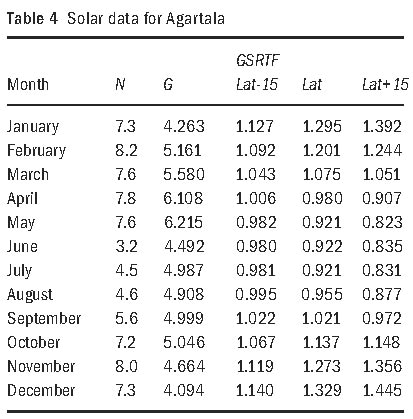 Explanation of symbols used in the tables N: Actual sunshine duration a day (in hours) G: Daily sum of global solar radiation (in kWh/m2) GSRTF: Global solar radiation tilt factors for south-facing surfaces for three tilt angles. Latitude –15° and Latitude +15°. To get ‘daily global radiation falling on the tilt surface’ (in kWh/m2), multiply ‘G’ with ‘tilt factor’. Agartala, Latitude: 23.88°N Source Reddy (2004). Energy Laboratory of the US Department of Energy) introduced the clearness index from the latitude information of the site under investigation. Solar resource and average daily radiation in a year are shown in Figures 6 and 7. 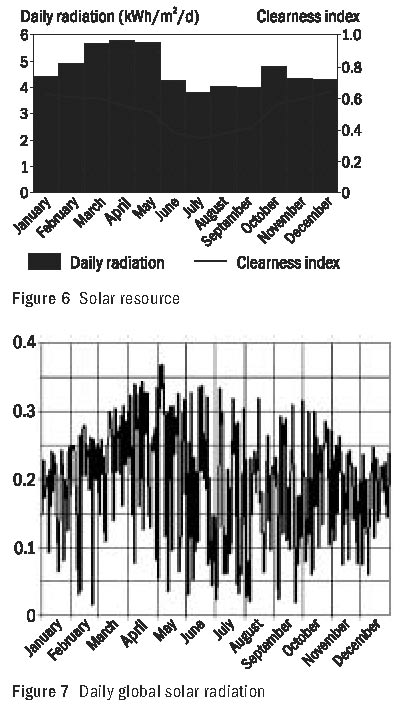 |
Biomass energy resource |
|
The economy of Tripura is mainly rural and agrarian. The state offers scope for the cultivation of a wide variety of agricultural crops because of its diverse topography, altitude, and climatic condition. Hence, owing to the large quantities of forestry, agricultural, and agro-industrial residues produced, entire state has huge potential of producing biomass. The agricultural residues so produced can be efficiently used to generate bio-energy, thus taking care of the disposal problem. Bioenergy activities that are designed with the involvement of local communities sensitive towards local environmental constraints and have a clear objective of meeting the identified needs of the poor can contribute significantly to the sustainable livelihoods of the rural people. Biomass energy has the potential to be modernized worldwide, that is, it can be converted efficiently into cost-effective and clean gas and liquid fuels or electricity by using various technologies. Most of these technologies are commercially available today. If widely implemented, such technologies would enable biomass energy to play a much more significant role in future, especially in developing countries. Power can be generated by biomass gasifier system. Among the North East states, Tripura is a pioneer state in installing 4 × 250-kW grid-integrated biomass-gasifier-based power plant, which is the largest in India and is located at Chowmonu block in Dhalai district. Another biomass-gasifier-based power plant is located at Lilagarh under Sabroom sub-division in South Tripura district. The economic viability of power generation basically depends on the minimum number of operating hours and availability of cheap biomass. The cost of biomass-based electricity is Rs 2.50–2.75 per kWh. When biomass is available free, the cost of gasifier-based electricity is lower. Table 5 shows that there is a wide gap between the potential of bio-energy and its actual development in North East states. The lack of progress in the non-conventional energy sector in the region has been due to a combination of factors such as poor awareness on the subject, absence of strong nodal agencies in the states, inadequate concessions, lack of proper monitoring and evaluation, shortage of trained manpower, non-availability of raw materials in the local markets, and poor quality of installation/maintenance. 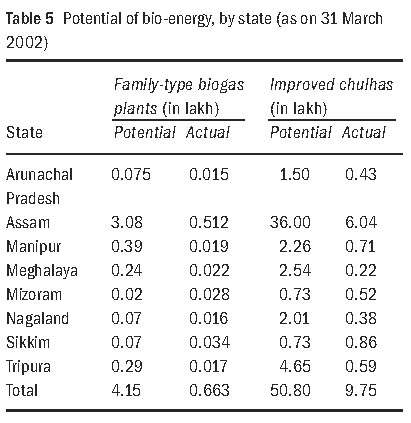 |
Wind energy resource |
|
In Tripura, only three wind-monitoring stations have been established so far by TREDA (Tripura Renewable Energy Development Agency), which assesses wind power potential of the state. These wind monitoring stations are located at Vanghmun, Fuldungsai, and Klungsang of Jampui Hills. Jampui Hills have excellent climatic conditions, and spring season is known to last throughout the year. Situated at an altitude of 3000 feet above the sea level, the Hills mark the highest altitude region in Tripura hill and are located about 250 km from Agartala. Besides, there are two weather stations for meteorological observations in Tripura. One is situated in Horticulture Research Complex, Nagicherra, West Tripura, and the other is situated at Agartala airport. Table 6 presents the wind velocity data of Agaratala for the last three years. Figure 8 shows the mean wind speed characteristics of Agartala, while Figure 9 gives the average hourly wind speed for one year. 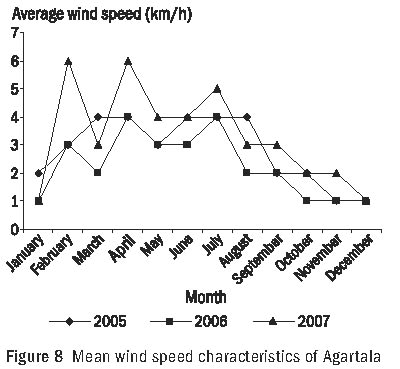 Generally, wind speed is found to be favourable for power generation in seashore area. Though Tripura is situated just 60–70 km away from Kaxbazar seashore in Bangladesh, the wind speed in the state is very low. The speed of the wind reduces drastically while it blows from Bangladesh to Tripura because ofobstruction caused by high-rises, large trees, and hills in Bangladesh. It is seen from the available data that the annual average wind speed of Agartala varies from 1 km/h to 6 km/h throughout the year, and the wind blows in other parts of Tripura in almost the same range. It has been estimated that an annual mean wind speed of about 18 km/h (that is, 5 m/s) or more is needed for the installation of an 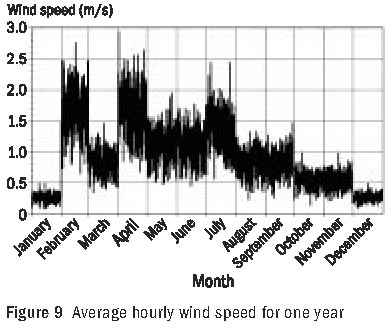 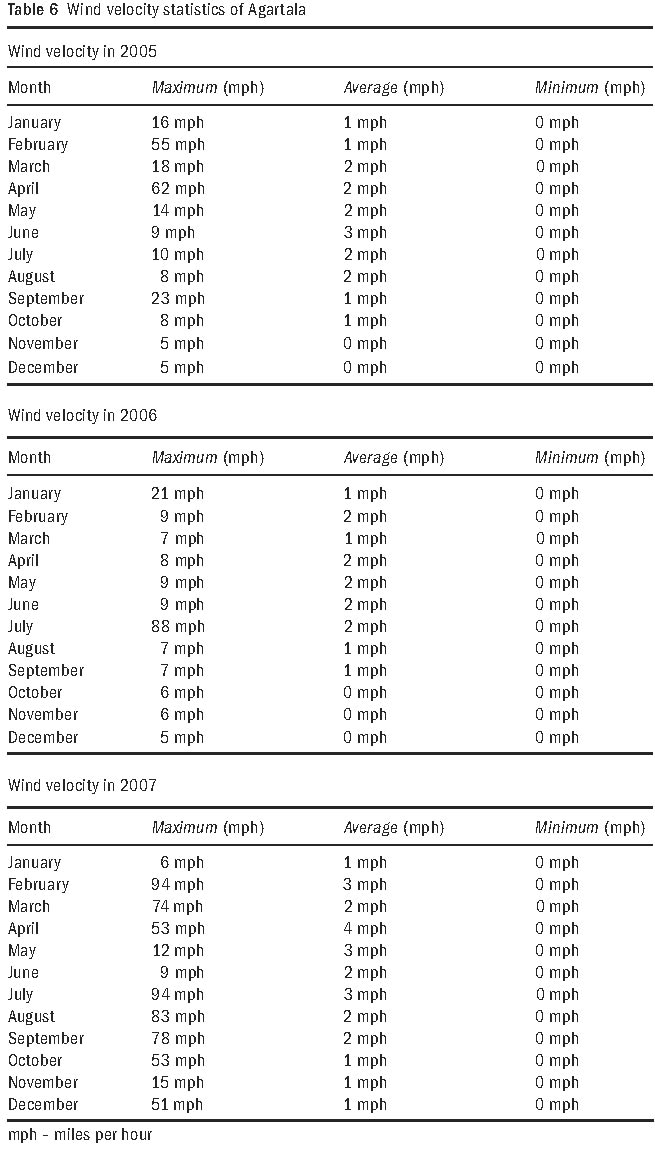 economically viable WTGS (wind turbine generator system). Power cannot be generated at all if the wind speed falls below 3 m/s. Therefore, it can be said that power generation from the wind is not viable for Tripura. However, it has been observed that at least for four months (that is, April to July), the wind speed is somewhat favourable in the state for power generation. The wind and solar resources of the state can be utilized for hybrid power project, which could be an economically viable option for harnessing wind power in the state. |
Hydro energy resource |
|
Among the various renewable sources of energy, small hydro is most significant as it generates decentralized power. Hilly regions with difficult terrain benefit the most from this source of energy. All projects between 3 MWand 25 MW are considered as small hydro projects. The geographic and climatic characteristics of the North East states make hydroelectric power system the most developed and preferred technology. Thirtyeightper cent of India’s hydropower potential lies in the North East region, but unfortunately, only 2% of this hydro potential has been tapped so far (Moral and Bhuyan 2004). Table 7 gives the hydropower potentialin the North East. It is reported in Vision 2020, a document that has recently been prepared for the overall development of eight North East states, that at least 2232-MW hydroelectric power generation is possible from all the natural water reserves present in the region and from the annual stored rainwater. According to the document, waterbodies occupy 5.63 hectares of the total area, and there are about 48 rivers in eight states of the North East. Total length of all the rivers and canals in the eight states of northeastern region is about 20 875 km. This watergets drained to the neighbouring country .jpg) Bangladesh, since facility to store and utilizemthis water has not been developed in the region as yet. Tripura receives adequate rainfall, and there is sufficient underground and surface water in the state. If rainwater is stored for one year, it can be used for generating power. Moreover, this stored water can be utilized for drinking and irrigation purposes for threeyears. It is possible to develop at least one power generation plant of 100-MW capacity in the state of Tripura, depending on the amount of rainwater stored. |
Conclusion |
| Immediate steps need to be taken for the development of all probable renewable sources of energy in the North East, which has a huge potential towards this end. From the foregoing discussion, it is clear that for effecting development of the region, there is a need for developing energy systems. The geographical and climatic conditions of the North East states, especially the state of Tripura, indicate that this region has the potential for developing solar- and biomass-based energy. If the integration of the above power-generating systems is properly planned, energy security of this area can be achieved. |
References |
|
Choudhury S. 1997 Proposal for a 500 MW combined cycle gas based thermal power plant in Tripura Paper presented at the Annual General Conference of The Institution of Engineers (India), 24 August, Agartala, organized by IE(I), ALC Ghosh P L. 2002 In search of non-conventional sources of energy Paper presented at the All India Seminar on Environment vis-à -vis Growing Population, 19–20 January, Agartala, The Institution of Engineers (India) (IEI) Ghosh B. 2005 Towards the energy security in North-East states of India Paper Presented at the Seminar on Application of Renewable Energy for Development of Tripura, Rajiv Gandhi Akshya Urja Diwas, 20 August, Tripura Engineering College, TREDA (Tripura Renewable Energy development Agency) Gupta B R. 2007 Generation of Electrical Energy New Delhi: Eurasia Publishing House (Pvt.) Ltd. 2 pp. Majumdar D. 2006 Financing renewable energy projects: lessons learned Paper presented at the International Grid Connected Renewable Energy Policy Forum, February, Mexico City Moral U and Bhuyan N. 2004 Power scenario of North East – vision and opportunities Paper Presented at the All India Seminar on National Electricity and Tariff Policy, 27–28 December, Agartala, The Institution of Engineers (India) (IEI), Central Electricity Authority Reddy P J. 2004 Science and Technology of Photovoltaics Hyderabad: BS Publications. 241 pp. Statistics of Tripura. 2006 Some Basic Statistics of Tripura–2006 Agartala: Directorate of Economics and Statistics Planning (Statistics) Department, Government of Tripura TREDA (Tripura Renewable Energy Development Agency). 2007 Various Non-conventional Energy Project Directives Agartala: TREDA |