| International Journal of Regulation and Governance
Vol.10(2) December 2010 Print ISSN : 0972-4907 |
Institutions, access, and entitlements to water supply: the case of urban households in the Cuddalore district, Tamil Nadu |
| V Nagaraj: PhD Research Scholar, Department of Economics, Annamalai University, Annamalai Nagar, Chidambaram, Tamil Nadu, India, 608 002. Email arputham.nagu@gmail.com and D Namasivayam: Professor and Wing Head, Economics Wing, Directorate of Distance Education, Annamalai University, Annamalai Nagar, Chidambaram, Tamil Nadu, India, 608 002. |
Abstract |
| This paper discusses the institutions, access, and entitlements to water supply in urban households in slum clusters and developed regions. The major institutions of water supply in the area of study are the municipal tap, self provision by groundwater sources, and water vendors. The planned urban limit and the unplanned urban limit are the sole factors that determine the institutional arrangements for water supply and the availability of combination of sources between the regions. Sen’s entitlements approach is applied for estimating access to water supply among different income groups, institutions, and regions. The study finds that the quantity of water access differs between the developed regions and the slum clusters, which highlights the inefficiency of institutional arrangements and the prevalence of inequality in water access. |
Introduction |
|
Domestic freshwater is a fundamental requirement for human welfare. At present, access to clean water is a great human development challenge, particularly within urban boundaries. The recent assessment by United Nations Centre for Human Settlements (UNCHS) 2006 estimates that about 970 million urban dwellers are without access to “adequate” water supply. Particularly, the poor families in the urban region do not have access to an effective water supply network (UNDP 2006; UNWWAP 2006). Migration, population growth, and urban expansion have led to a huge increase in water demand in urban regions. Thus, the provision of safe drinking water is also a prominent point on the government policy agenda. As a result, multilateral and bilateral organizations have extended financial assistance to improve access to water supply in urban regions. However, the drawbacks in the implementation of the policy and the political environment of the state meant that the state has failed to achieve its target as far as urban water supply projects are concerned. At this juncture, private water suppliers emerged as a major institution in the urban water supply sector. The private water supply institution includes public private partnership (PPP), contracts, packaged drinking water, and local tankers. However, private sector participation has negatively affected the people by raising the cost of capital—large amount of money is required for repair, replacement, and high tariff—which has reduced accessibility to and affordability of drinking water (Madhav 2008). Due to the failure of the public and private sectors, inequality in access to safe drinking water has widened its reach, enveloping a large number of urban households. When the supply and access to water become unequal and inadequate few people have access to enough water while others do not. In such a scenario, it is well recognized that institutions, access, and entitlements to water supply in urban households is a prerequisite for any water resource policy design. Therefore, the present study attempts to analyse institutions, access, and entitlements to water supply in urban households. |
Overview of literature |
|
The pioneering studies on institutional arrangements for urban water supply are mainly devoted to urban India. The studies reveal the challenges in institutional arrangement; formal and informal water supply institutions; institutional changes in public sector water utilities and efficiency of water supply institutions; reforms in water supply institutions and governance; and the factors responsible for efficiency of institutional arrangements. The studies expect realignment of institutional arrangements by implementing effective institutional reforms in terms of accountability; transparent and balanced approach between formal and informal water utilities; homogenous pricing policy; user participation; and the role of the government in provision of water (Shyam 2000; Marie and Marie 2003; Connors 2005; Gupta 2006; Nallathiga 2006; Bouselly 2006; Huchon and Tricot 2008). Studies on access to water supply in urban households in India report that most people do not have enough access to water. Urban poor households depend on their neighbours for water, while a few travel long distances for the same (Bajpai and Bhandari 2001; McKenzie and Ray 2009). The existing studies on entitlements to water supply in urban households are very scanty. The idea of entitlements to urban water supply was articulated and discussed by Webb and Iskandrani (1998) at the policy level with regard to slum households. Anand (2001 and 2004) has used the entitlement approach to water supply by following Sen’s entitlements approach to examine the inequality in water access at the metro city level. Given this background, the present study analyses the water supply in urban households by using the entitlements approach. Besides, this paper interlinks supply and access to water in different regions—a new attempt in the area of research. |
Application of Sen’s entitlements approach for analysing inequality in water access |
|
The issue of inequality in water access is similar to Sen’s entitlement approach. Sen’s approach to “famine and starvation” states that “starvation is the characteristic of some people not having enough food to eat and it is not the characteristic of all not having enough food to eat” (Sen 1981). Similarly, applied to the problem of water access and supply, the approach would take into account some people not having enough water rather than all not having enough water. Sen’s entitlement approach includes three conceptual ideas—endowment, entitlement, and entitlement mapping. The idea of endowment defines resources legally owned by a person, conforming to established norms and practices, including tangible and intangible assets. The concept of entitlements refers to all possible combinations of the commodity that a person can legally acquire by using the resource endowment. Entitlement mapping explains the relationship between endowment and entitlement. In the context of water access, the urban households regularly obtain water from various institutions. Therefore, the use of endowment estimation is more relevant than the process of exchange entitlements. Based on this, the present study uses the entitlements approach to analyse the problem of inequality in water access and institutions governing access to water supply. Besides, there are some vital reasons for applying Sen’s entitlement approach to water supply for understanding the inequality in access to water supply in urban households. 1. According to the urban regions (town panchayat, municipality, and corporation), the litres per capita per day (lpcd) of water is determined. If the supply falls below a considerable level, the problem of inadequate water supply arises, where the people have to look for alternative sources that involve money, time, and labour. 2. The slum dwellers in large cities like Mumbai face shortages of clean water, while their neighbours in high-income suburbs have enough water, not only to meet household needs, but to keep their lawns green and their swimming pools topped up (UNDP 2006). This confirms that some of the urban households face scarcity of water even though water is available in the urban regions. 3. The concept of “counter-movement” is explained by Sen (1983) in his analysis of the entitlement approach to “famine and starvation” in terms of availability of food in places that are away from famine-stricken regions. Likewise, the processes of globalization, liberalization, and privatization have led to the development of most large corporations adjacent to the urban agglomerations. Due to this, large quantities of freshwater are consumed by the industries for their production process. This has drastically reduced the availability of domestic water for urban households. 4. Sen (1976) says that famine depends not merely on production, but also on distribution. This theory does not really explain the problem of the Food Availability Decline (FAD) analysis. Similarly, few urban local bodies having abundant freshwater sources suffer due to inefficient and complex water supply institutions. 5. Sen (1987) suggests delivering food directly to the people as an effective measure for combating famine. Similarly, the urban local bodies (ULBs) have to supply water to all, whenever required; the authorities have to supply water by tankers to the interior regions. |
The data: urban areas surveyed and sample design |
|
For analysing the institutions, access, and entitlements to water supply in urban households, multi-stage, disproportionate random sampling method was adopted for selecting the study region. At first, urban water supply performance of high poverty districts (Tamil Nadu Human Development Report 2003), such as Cuddalore (70.19%), Dindigul (77.39%), Kanyakumari (45.71%), Thoothukudi (61.09%), Thirunelveli (70.54%), and Thiruvannamalai (78.36%), were compared. Of the six districts, the Kanyakumari, Thirunelveli, and Cuddalore districts have lower number of urban households with protected water supply. In the second stage, of the three districts, the Cuddalore district is selected for three reasons. First, the geomorphological conditions of Kanyakumari are akin to a hilly region; it prevents water supply coverage with unfavourable consequences in urban regions. On the other hand, it has a number of alternative protected water supply sources like wells. Second, the Thirunelveli district has the Thirunelveli City Corporation within its boundaries and the water supply setup of the corporation is totally different as compared to urban regions like municipalities. Third, the water supply performance of the Cuddalore district (65.86%) is very close to that of the state (62.53%). Thus, the Cuddalore municipality was selected for the study. The wards were classified as developed and slum regions in the third stage. In the fourth stage, 50 households from each region were surveyed by using a pre-tested and structured interview schedule, which included socio-economic characteristics, institutions, access, and entitlements to water supply. The study was conducted during the normal season (in order to avoid bias) in the year 2008/09. The total water supply capacity of the municipality is 6.35 million litres per day (MLD). It provides 7205 water supply connections, which include 3442 domestic flat rate connections, 3238 domestic metered connections, 350 public connections, and 175 commercial connections. |
Institutional arrangements for water supply |
The provision of water supply in urban area has, for long, been a function of municipalities and this is the case in many urban centres even today. The ULBs have different models of institutional arrangements (Figure 1). First, the municipality is responsible for capital works, operation, and maintenance, and provision of water supply. Second, capital works are executed by state-level agencies, and operation and maintenance and water supply services are performed by the municipalities. Third, in metropolitan cities, citylevel water supply and sewerage boards have been constituted to perform the functions of construction, operation, and maintenance of water supply (NIUA 2000).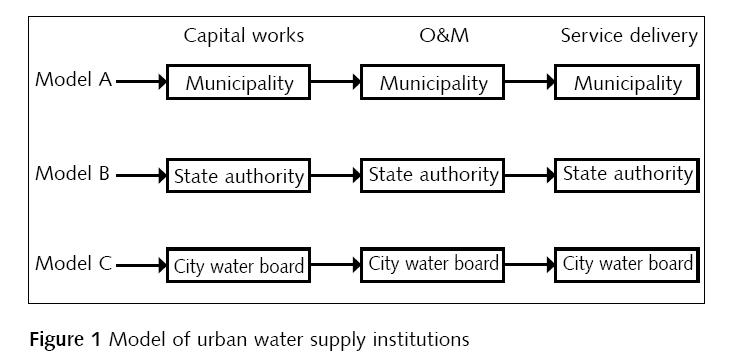 In the Cuddalore municipality, Model B is being practiced. In recent years, the Tamil Nadu Water Supply and Drainage Board has constructed overhead tanks and water supply pipelines, wherein the maintenance is given to the Cuddalore municipal authority. |
Water supply institutions in Cuddalore municipality |
|
Arrangements for urban water supply in the Cuddalore municipality have been managed by various institutions. In the surveyed regions, one individual household connection and six public connections are availed of in the slum area, whereas 25 individual household connections and two public connections exist in the developed area. In case of groundwater sources, three public and 14 private hand pumps as well as three public bore wells and three private bore wells are present in the slum area. The developed area has four public, seven private hand pumps, and 21 private bore wells. The urban households depend on various water supply institutions for their daily requirements, which are as follows. (i) Municipal connection: household and public tap (ii) Self provision: groundwater sources (iii) Retail sources: packaged water and water vendors Based on the institutional set up, the dimension of water supply institutions in slums and developed regions are given in Table 1. In the Cuddalore municipality, 34% of the households use both tap and hand pump for water and 16% of the households depend on tap and bore well, while tap is the major source of water supply for 13% of the households. On the whole, more or less 84% of the households depend on more than two sources of water supply for their daily requirements. 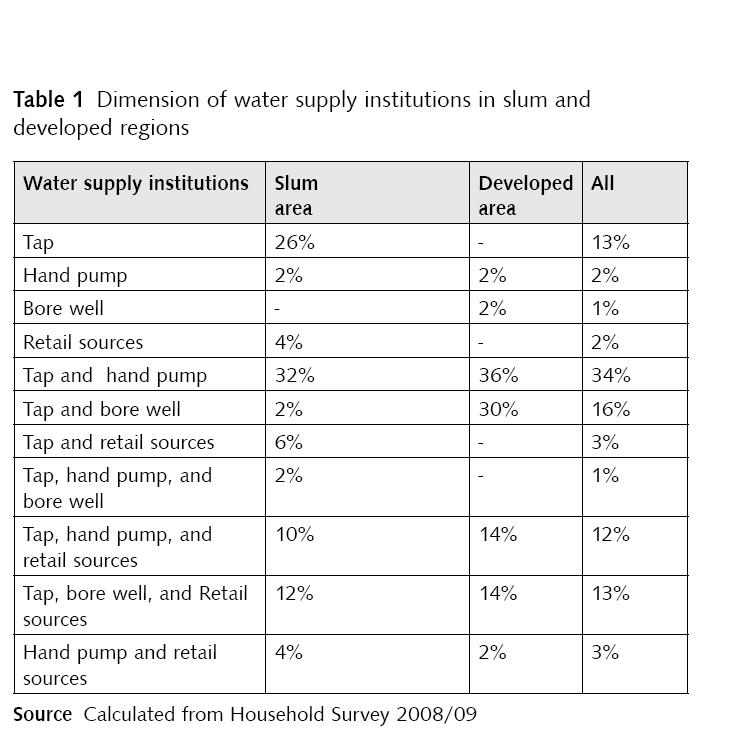 In case of slum area, 32% of the households use public tap and hand pump as a major source of water supply, while 26% of the households purely depend on public tap. In all, 28% of the slum households use more than two sources of water supply. But, in the developed region, 36% of the households use house connections and own hand pumps, 30% of the households use house connection and own bore wells. Further, 30% of the households in developed region use more than two sources of water supply. Thus, the households in both the slum area and the developed regions depend on more than one source of water supply. The above discussion identifies the factors responsible for complex institutional arrangements in urban water supply. The developed area is located within the planned urban limits, which provides legal approval for the water connection. Moreover, higher economic status facilitates the use of groundwater resources by bore wells and purchase of water from retail stores and vendors. The slums are located away from the central urban area, within the unplanned urban limits. It prevents them from availing the tap connection and forces them to depend on the public tap. Hence, more than 10 households depend on one public water connection, which leads to conflicts among the slum households. In addition, pipe connections are not managed by the slum households and they have to travel long distances, to the developed areas, to fetch tap water. Thus, inadequate groundwater extracting facilities and saline groundwater limits the use of the same in slum clusters. |
Access to water supply |
|
According to government reports, the urban water supply performance of the state of Tamil Nadu (65.40%) and the Cuddalore district (70.19%) has come close to achieving the Millennium Development Goals in water supply, in terms of the expansion of water supply infrastructure facilities. In reality, however, the water supply situation is not as good as the figures shown in the reports. In addition, water supply in most urban regions in India is availed for only a few hours every day with the quality of supply being poor. The average quantity of water access from various water supply institutions per household is presented in Table 2. In the Cuddalore municipality, 78% of the total quantity of water is accessed from groundwater sources like tube wells and hand pumps and the remaining 20% and 2% of water is accessed form tap and retail sources, respectively. In terms of litres, the average water access per household is 822 litres. Of the total quantity of water accessed, 162 litres are accessed from municipal sources, 641 litres are accessed from groundwater aquifers, and 19 litres are accessed from retail sources. 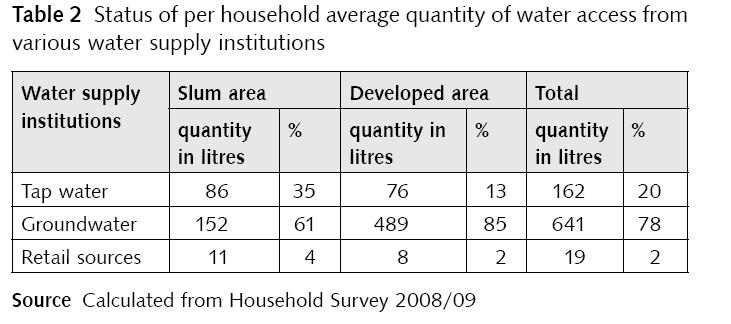 In the slum area, the average quantity of water access per household is 249 litres. According to the institutions, 86 litres comes from the tap source, 152 litres comes from groundwater, and 11 litres is availed from retail sources. In terms of percentage, 61% is extracted from groundwater, 35% is accessed from the tap, and the remaining 4% is accessed from retail sources. The average quantity of water access in the developed regions accounts for 573 litres. The average quantity obtained from the tap source, groundwater, and retail sources are 76 litres, 489 litres, and 8 litres, respectively. The water access characteristics of the slum and developed regions are homogenous in nature. The discussion reveals that the average quantity of water access in developed households is comparatively higher than the slum households. In general, the quantity of water accessed differs between the households in the developed and slum regions in the municipality. The households in the developed region accessed 324 litres more than the slum households. In addition, groundwater in slums is saline and not very useful since the slums are located close to the backwaters of the sea. Thus, slum households are unable to obtain adequate quantity of water for their daily purposes. Thus, access to water supply from various institutions precludes complex and incompetent institutional arrangements and the prevalence of inequality in the access to water between slum households and the developed regions. |
Entitlements to water supply in urban households |
| Sen’s entitlements approach to famine defines that endowments refer to the resources legally owned by a person, conforming to established norms and practices. The water endowment refers to the quantity of water accessed by different institutions of water supply including public and private institutions. |
Per capita water endowments and water supply institutions |
|
For calculating per capita water endowments, the quantity of water accessed from various water supply institutions is divided by the total population of the surveyed households. Per capita water endowments (in lpcd) = tap + groundwater + vendor/total population. Per capita water endowment from various water supply institutions is given in Table 3. 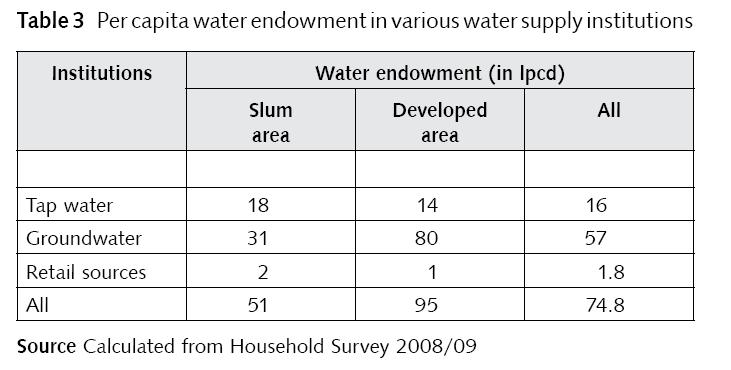 Per capita water endowments are discussed by institution as well as by region. The average per capita water endowment in the Cuddalore municipality is 74.8 litres; that is, 51 litres in the slum area and 95 litres in the developed area. Per capita water endowments are fulfilled by groundwater, tap, and retail sources, respectively. The per capita endowments from groundwater accounts for 57 litres, 16 litres from the tap source, and 1.8 litres endowed from retail sources. The per capita endowment from groundwater sources is absolutely high in the Cuddalore municipality. The same trend exists in both slum and developed regions. The per capita groundwater endowment is above average in the developed region as compared to the slum region. |
Households water endowments as per income groups and regions |
The analysis of household water endowments in terms of income groups and regions is essential in order to explore the inequality in water access by applying the entitlements approach (see Table 4). Income groups are classified as low (up to Rs 60 000), middle (above Rs 60 000 and upto Rs 150 000), and high (above Rs 150 000). Water endowment in terms of litres per capita per day are classified as 0–25 lpcd, 26–50 lpcd, 51–75 lpcd, 76–100 lpcd, 100–125 lpcd, 126–150 lpcd, and 151–217 lpcd.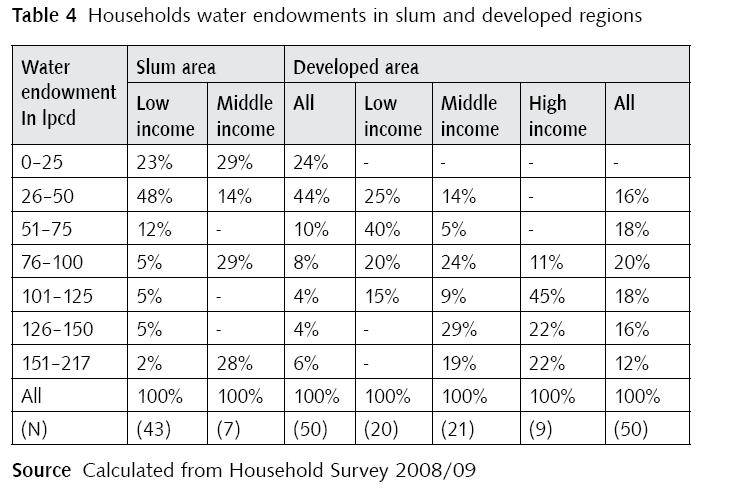 In the slum area, 86% of the individuals fall under the range of up to 100 lpcd and 14% are endowed in the range of 101–125 lpcd to 156–217 lpcd. It is divided between the middleand low-income slum households. Ownership of groundwater facilities helps households attain higher endowments in the middleincome slum households rather than the low-income households. In the developed region, 0–25 lpcd endowment is not reflected in the above data. In all, more than 50% of the developed households were endowed more than 100 lpcd. According to income groups, 85% of low-income households belong to the category of above 100 lpcd endowment, whereas the middle-income households are scattered across endowments. In the high income group, the first three endowments are availed and majority of the individuals have higher water endowment status. The above discussion of per capita water endowments from water supply institutions and per capita water endowments with regard to income groups and regions highlights inequality in access to water supply. Further, the estimation of water endowment is a fruitful tool to measure equality, rather than the households having protected water supply facility and per capita water availability. It urges the policy-makers to realize the causes for inequality in distribution and access in different regions of the municipality. |
Conclusion |
|
The urban households depend on multiple institutions for water supply. Water supply institutions favour the developed regions. The planned status legal approval of the urban limit facilitates adequate water supply. These factors place the slum households outside the legal purview and as a result force them to depend on public taps with high dependency per connection. On the contrary, huge amounts charged as connection deposits, fitting, and other charges exclude majority of the low-income households and some of the middleincome households in developed area. The quantity of water access differs between households in the developed and the slum regions within the municipality. The households in the developed region access 324 litres higher than slum households. On the other hand, quantity of access from groundwater is high as compared to other institutions like tap and water vendors. It proves that inefficient institutional arrangements and the prevalence of inequality in water access have adversely affected the households in slum clusters and in the developed region. The entitlements approach is applied for the estimation of water endowments, through per household water endowments (water supply institutions) and per capita water endowments (income groups and regions). The study finds that there is inequality in access to water supply in terms of income groups, institutions, and regions. Especially, the present study introduces a tool for analyzing the urban water sector in place of earlier estimation parameters such as percentage of households having protected water supply facility and water availability. In future, it will provide referential help to policy-makers, planners, and executives for framing policies and implementing them. |
References |
|
Anand P B. 2004. The political economy of water scarcity and issues of inequality and identities: a tale of two cases from South India. International Journal of Technology Management and Sustainable Development 3(2): 115–132. Anand P B. 2001. Water scarcity in Chennai, India: institutions and entitlements and aspects of inequality in access. WIDER Discussion Paper, No.140. United Kingdom. Bajpai P and Bhandari L. 2001. Ensuring access to water in urban households. Economic and Political Weekly 36 (39): 3774–3778. Bouselly L, Gupta S, and Ghosh D. 2000. Water and urban poor. National Institute of Urban Affairs Working Paper, No.11. New Delhi. Connors G. 2005. When utilities muddle through: pro-poor governance in Bangalore’s public water sector. Environment and Urbanization 1: 201–217. McKenzie D and Ray I. 2009. Urban water supply in India: status, reform options, and possible lessons. Water Policy 11(4): 442–460. Government of Tamil Nadu. 2003. Tamil Nadu Human Development 2003. New Delhi: Social Science Press. Gupta S, Kumar S, and Sarangi G K. 2006. Measuring the performance of water service providers in urban India: implications for managing water utilities. National Institute of Urban Affairs Working Paper, No. 06. New Delhi. Huchon A and Tricot G. 2008. Between citizens and institutions: the dynamics of the integration of water supply and sanitation services in Hyderabad. Centre for Social Sciences and Humanities Occasional Paper, No. 22. New Delhi. Madhav R. 2008. Tirupur water supply and sanitation project: an impediment to sustainable water management? International Environmental Law Research Centre Working Paper, No.1. Geneva. Lorente M L and Zerah M H. 2003. The urban water sector: formal versus informal suppliers in India. Urban India 22 (1): 1–15. Ramakrishna N. 2006. Reforming water sector governance and institutions for improving efficiency: the case of Mumbai. International Journal of Regulation and Governance 6(1): 43–77. NIUA. 2000. Urban Statistics Handbook 2000. Delhi: National Institute of Urban Affairs. Sen A K. 1986. Economics and entitlements. WIDER Discussion Paper, No.1. United Kingdom. Sen A K.1983. Conflicts in access to food. International Foundation for Development Alternatives Paper, No. 35. United Kingdom. Sen A K. 1976, Famines as failures of exchange entitlements. Economic and Political Weekly 11 (31/33): 1273–80. Sen A K. 1981. Poverty and famine: an essay on entitlement and deprivation. USA: Oxford University Press. Dutta S S. 2000. Partnerships in urban development: a review of Ahmedabad’s experience. Environment & Urbanization 12 (1): 13–26. UN. 2006. United Nations world water assessment programme: water a shared responsibility. USA: New York. UNCHS. 2006. Meeting development goals: water sanitation in the world cities 2006. London: Earthscan. UNDP. 2006. Human Development Report 2006: Beyond scarcity: power, poverty, and the global water crisis. USA: New York. Webb and Iskandarani. 1998. Water insecurity and the poor: issues and research needs. Development Policy Discussion Paper, No. 2. University of Bonn, Germany: Walter-Flex-Strasse. |